

What Powers the AI Inside Your Tesla
The Hardware: From HW3 to AI4 and AI4 Plus
If you own a Tesla Model 3 or Model Y, there is a computer in your car that does nothing but run the AI. It is not the same computer that runs the touchscreen or the navigation system. It is a separate board, about the size of a thick paperback, designed for one job: looking at camera images and deciding what to do.
There have been several versions of this computer. The older one, Hardware 3 or HW3, was used in cars built from 2019 to about 2023. It worked fine for basic Autopilot features. But as Tesla’s neural networks grew bigger, HW3 started to struggle. The memory bandwidth — how fast the computer can shuffle data around — became the limit. Tesla eventually admitted that HW3 cannot run the latest Full Self-Driving software at its full capability.
Hardware 4, also called AI4, replaced it. AI4 has about eight times the memory bandwidth of HW3. It processes higher-resolution video and runs larger neural networks. Every new Model 3 and Model Y sold in 2025 and 2026 has AI4.
In April 2026, Tesla announced AI4 Plus. It doubles the memory from 32 gigabytes to 64 gigabytes and adds about 10 percent more compute power. Production is expected in mid-2027. Tesla says AI4 is already good enough for unsupervised self-driving. Whether that is true — they said the same thing about HW3 — we will find out.
The Software Philosophy: End-to-End Neural Networks
The real change in how Tesla’s AI works happened in the software, not the hardware.
Older self-driving systems broke the problem into pieces. One module detected objects. Another module predicted where those objects would go. A third module planned the route. Each piece was written separately by engineers. It worked, but it was fragile. If one piece failed, the whole thing broke.
Tesla switched to what it calls an end-to-end neural network. Instead of separate modules, a single large network takes in camera images and directly outputs driving commands. The network learns everything from training data, not from rules written by humans.
This is why Tesla’s approach is different. The car does not know what a stop sign is because an engineer told it. It knows because it has seen millions of stop signs in training data and learned what they look like and what to do. The system can handle situations the engineers never specifically programmed for.
How the Car Sees the World
Cameras Only: Why Tesla Chose Vision Over Lidar
Most companies working on self-driving cars use cameras, radar, and lidar. Lidar shoots laser beams and measures how long they take to bounce back, building a precise 3D map of the world. It is expensive but accurate.
Tesla went a different direction. Starting in 2022, the company removed radar from the Model 3 and Model Y. Newer cars also removed the ultrasonic sensors used for parking. The camera-versus-lidar debate is one of the most argued topics in the autonomous driving world.
Tesla’s argument is simple. Cameras are cheaper. They can see color, texture, and road markings that lidar cannot. And humans drive with just two eyes — no lasers needed. If humans can navigate with vision alone, Tesla says, a properly trained neural network should be able to do the same.
The trade-off: cameras struggle in the same conditions humans do. Heavy rain. Fog. Direct sunlight. Darkness. Lidar does not have those problems. Tesla believes that with enough training data and better networks, cameras will eventually outperform lidar. Critics say the gap is built into the technology and cannot be closed with software alone.
360-Degree Visibility and Real-Time Processing
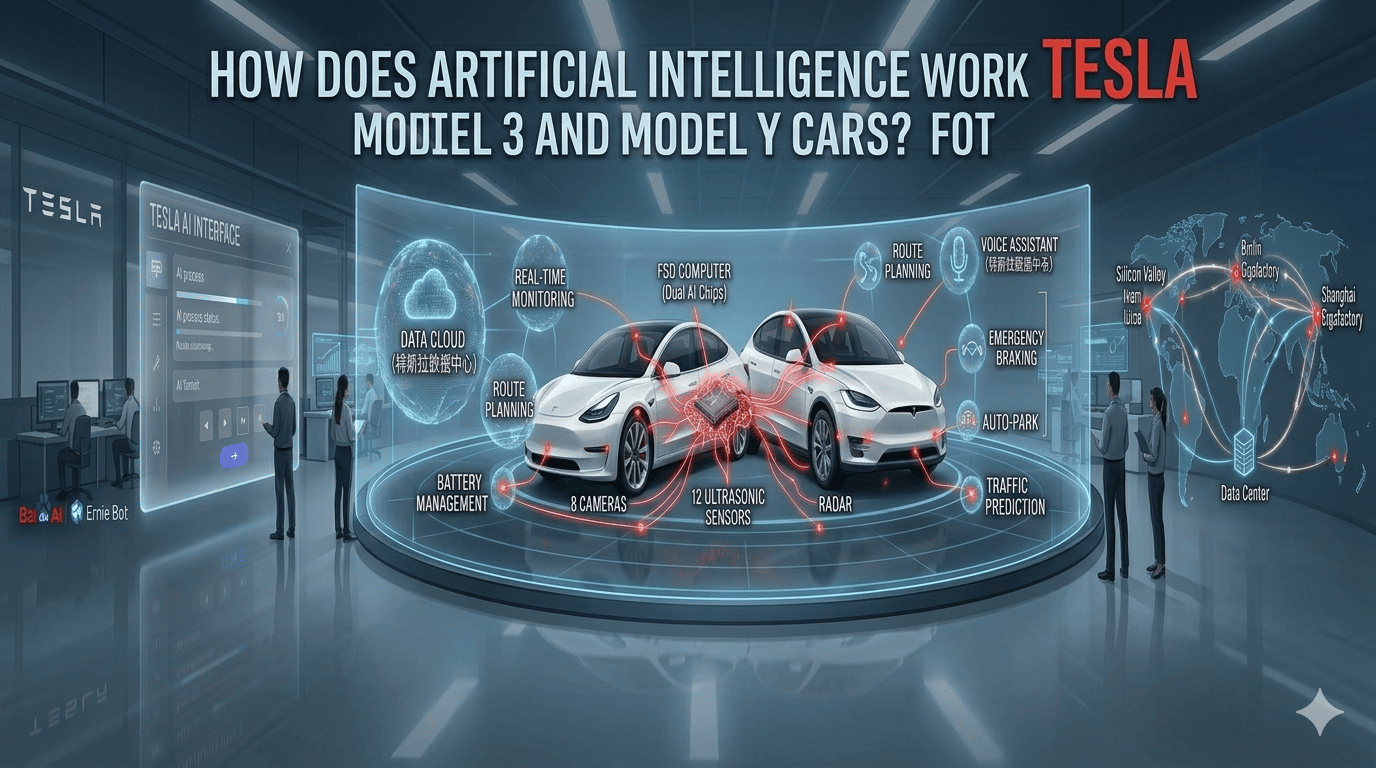
The Model 3 and Model Y have eight cameras around the car. Three face forward. Two face to the sides, mounted in the fender repeaters. Two face to the rear. One faces backward above the license plate.
Together, they give the AI a full view around the car. The system can see vehicles approaching from the side, pedestrians stepping into the street, and traffic lights at intersections it has not reached yet. All eight camera feeds go into the neural network at the same time.
The AI4 computer processes these images at full resolution, 36 times per second. Every 28 milliseconds, the system gets fresh images, runs them through the network, and produces new driving commands. The delay between seeing something and acting on it has been cut significantly. In FSD v14.3, Tesla rewrote the AI compiler using a system called MLIR, reducing reaction time by 20 percent.
How the Car Thinks
From Raw Pixels to Driving Decisions in Milliseconds
When the cameras capture an image, the neural network does not just identify objects. It builds a complete picture of the driving scene.
The network recognizes lane markings, curbs, traffic lights, stop signs, other vehicles, pedestrians, cyclists, and unusual objects like construction barrels or debris. It estimates the distance and speed of every moving thing. It predicts where those things will be in the next few seconds. It figures out where the car can safely drive.
All of this happens in one pass through the network. There is no separate step for detection followed by a separate step for planning. One network does it all and picks the best path forward.
Tesla’s FSD v14 improvements include an upgraded vision encoder that strengthens 3D understanding and improves recognition in low visibility. The system is better at understanding what it is looking at, even when conditions are bad.
The Human-Like Discriminator: What Makes V14 Feel Different
Here is the part I find most interesting. Tesla’s AI does not just pick the safest path. It picks the path that feels most natural.
You have surely noticed if you have tried FSD v14 that the car drives more smoothly than it used to. There is a reason for that. A patent published in 2026 reveals how Tesla achieved this. The system uses something called a hierarchical nodal graph to evaluate every possible move. For each action, the AI gives three scores.
Collision risk is the first score, and it is non-negotiable. If a move would cause a crash, the computer rejects it immediately.
Comfort is the second score. Will this move jerk the passengers? Will it spill a coffee in the cupholder? The AI has learned what comfortable driving feels like from millions of miles of human driving data.
The third score is the most revealing. It is called the human-like discriminator. The AI asks itself: is this how a real person would drive? The system has been trained on a massive database of actual human driving. It knows how people handle an unprotected left turn. It knows how people merge into heavy traffic. It scores its own moves against that database and picks the ones that match real human behavior most closely.
This is why FSD v14 feels different from earlier versions. The robotic hesitation and overly cautious braking are mostly gone. The car drives with confidence because it is measuring itself against human drivers, not against a safety threshold that encourages timid behavior.
Aggressive Pruning: How the AI Rejects Bad Ideas Instantly
The scoring system also gives Tesla a speed advantage. Because the AI evaluates every possible move in real time, it can instantly throw away branches that score poorly.
If the system considers a lane change and the human-like discriminator gives it a low score — maybe because it would cut off another driver — the computer stops thinking about that option immediately. It does not waste time on paths that lead nowhere.
This technique, called aggressive pruning, is the hidden reason Tesla can run advanced AI on the current AI4 hardware. By rejecting bad ideas early, the system reduces the total workload. The network does not have to calculate every possible future. It only calculates the futures that score well.
This is also the key to backward compatibility. Tesla is working on a version of FSD v14 called v14 Lite that will run on older HW3 computers. Aggressive pruning cuts the processing demands enough that the older hardware can keep up.
How the Car Learns
The Fleet as a Training Ground: Billions of Miles of Data
Tesla has an advantage no other automaker can easily copy: a fleet of over six million cars on the road, each one with cameras and an internet connection.
Every time a driver encounters something unusual — a construction zone, a car stopped in the middle of the road, a pedestrian crossing where there is no crosswalk — the car can record it and send it back to Tesla. Engineers use these clips to train the network on rare situations.
When a driver takes over from Autopilot or FSD, that moment is especially valuable. It tells Tesla’s training system exactly where the AI made a wrong decision. The system learns from its mistakes continuously.
This fleet learning loop is why your Model Y gets smarter after you buy it. The car you drive today runs on knowledge extracted from millions of other trips. Tomorrow, after another million trips are processed, the network improves again.
Reinforcement Learning and the Dojo Supercomputer
Training a neural network at this scale takes enormous computing power. Tesla built its own supercomputer, called Dojo, for this purpose. Dojo processes the massive amounts of video from the fleet and trains new versions of the network.
The training uses a technique called reinforcement learning. Instead of showing the network labeled examples of good and bad driving, it learns through trial and error. The AI tries different moves in simulation. It gets a reward when it does something right — like completing a turn smoothly — and no reward when it does something wrong. Over millions of simulated tries, the network figures out which behaviors work best.
FSD v14.3 improved this reinforcement learning stage. Tesla focused the training on harder examples — the situations where the AI was most likely to make mistakes. By training more aggressively on edge cases, the system improved across a wide range of driving scenarios.
Why Your Model 3 Gets Smarter After You Buy It
Here is something that still surprises people. Because the AI is software, it can improve without new hardware.
When Tesla releases a new version of FSD — roughly every few months — the update installs over the air, just like a phone update. The neural network inside your car is replaced with a newer, better-trained version. The cameras and computer stay the same, but the software that interprets what they see gets better.
This is why a 2023 Model 3 with AI4 hardware can drive significantly better in 2026 than it did when it was new. The hardware was always capable. The software just needed more training.
What the AI Can Actually Do Today
FSD vs Autopilot: What You Get at Each Level
Tesla sells several tiers of driver assistance, and the names confuse almost everyone. Here is what each one does as of 2026.
Basic Autopilot gives you Traffic-Aware Cruise Control, which keeps your speed and following distance, and Autosteer, which keeps the car centered in its lane on highways. Starting in 2026, new Model 3 and Model Y cars in North America no longer include Autosteer as standard. You only get cruise control unless you pay for FSD.
Enhanced Autopilot adds Navigate on Autopilot (highway guidance from on-ramp to off-ramp), automatic lane changes, Autopark, and Summon. It is available as a separate purchase on some models.
Full Self-Driving (Supervised) is the top tier. It includes everything in Enhanced Autopilot plus Autosteer on city streets, traffic light and stop sign control, and the most advanced path planning. FSD can navigate complex urban streets, make left turns across traffic, and handle roundabouts.
In early 2026, Tesla moved FSD to a subscription-only model for new customers. The price is about $99 per month in the US. The option to buy FSD outright for a one-time payment is gone.
The Honest Limit: Level 2 Supervision Still Required
Despite the name “Full Self-Driving,” the system is not fully self-driving.
Under the SAE classification, Tesla’s FSD is Level 2. The car can control steering and speed, but the driver must watch the road at all times and be ready to take over. Tesla uses a cabin camera to track whether the driver is paying attention. If it detects you looking away, it warns you and can eventually shut off FSD for the rest of the trip.
This matters because the marketing language sounds more advanced than the legal reality. FSD handles many situations impressively well. But it still makes mistakes. It can misjudge an intersection. It can hesitate when it should go. It can fail to recognize an unusual obstacle. The driver is always responsible.
Tesla’s goal is Level 4 or Level 5, where the car can drive without any human supervision. The company has not gotten there yet. When it will — and whether the current hardware is enough — are open questions.
Where the Technology Is Headed
AI4 Plus and the Unsupervised Promise
Tesla’s current position is that AI4 hardware is already capable of unsupervised self-driving. Elon Musk said on the Q1 2026 earnings call that AI4 can achieve “far greater than human safety levels” and that the next chip, AI5, will go into robots and data centers, not cars.
At the same time, Tesla announced AI4 Plus with doubled memory and more compute. The contradiction is obvious: if AI4 is already enough, why upgrade it?
The honest answer is that neural networks keep growing. The models needed for unsupervised driving in 2028 or 2029 will likely be bigger than what runs on today’s AI4. AI4 Plus extends the runway. Whether it extends it far enough, only time will tell.
The Robotaxi Question
Tesla has announced plans for a robotaxi called Cybercab — a vehicle with no steering wheel or pedals that would drive itself. The robotaxi would use the same AI technology that runs in Model 3 and Model Y today.
If Tesla achieves unsupervised FSD, every AI4-equipped Model 3 and Model Y could potentially earn money for its owner by operating as a robotaxi. You would send your car out to pick up passengers while you are at work or asleep. Tesla would take a cut.
This vision is years away. It needs regulatory approval in every market. It needs the AI to be genuinely safe without supervision — a much higher bar than the current system. And it needs public trust, which is still being built.
Whether the robotaxi future arrives in five years or ten or never, the core technology is the same. The cameras on your Model 3. The AI4 computer behind the glovebox. The neural network trained on billions of miles of real driving. These are the pieces. The rest is a question of time, training, and trust.

Independent technology writer focused on artificial intelligence, emerging technologies, and digital innovation. Covers AI applications in sports, productivity, and online business.