





































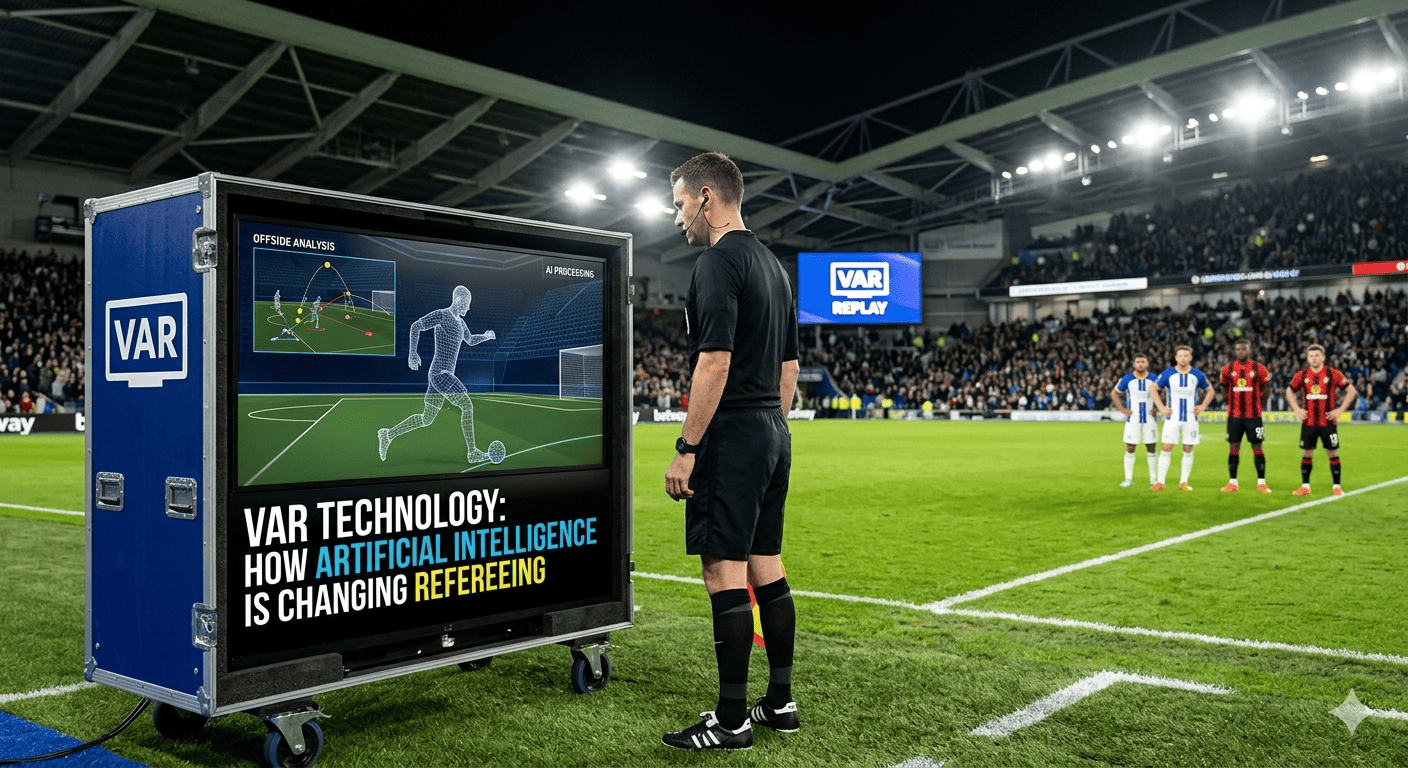
VAR started as a simple replay system — a referee watching video after the whistle. Today, artificial intelligence does much of the work before the whistle even blows. AI-powered cameras track players, detect offsides automatically, and predict ball trajectories in real time. This article explains how VAR technology uses AI, from computer vision to machine learning models, and what that means for the future of sports officiating.
Video Assistant Referee — VAR — has been one of the most talked-about technologies in sports. Fans argue about its decisions every week. But behind the controversies, the technology has changed dramatically. What started as a human referee watching slow-motion replays has become an AI-powered system that tracks every player, detects offsides in seconds, and alerts officials to potential fouls. This article looks at the role of artificial intelligence in the development of VAR technology and how AI in VAR is changing how refereeing works, bit by bit.
What Is VAR and How Does It Work?
The traditional VAR setup
The original VAR system relied on multiple camera angles and a team of human referees watching screens. When the on-field referee made a potential mistake, the VAR team reviewed footage and communicated through headsets. The process was slow and still depended on human eyes spotting the right frame. Reviewing an offside call could take two to three minutes. The system was helpful, but it was not smart.
Where human referees fall short
The human eye can only track so much. In a fast football match, a referee has to watch 22 players, the ball, and multiple possible rule violations at the same time. Studies show that referees miss around 15% of fouls in real time. Offside calls are especially hard because they require checking the exact moment the ball is played. That split second is where artificial intelligence refereeing makes the biggest difference.
How Artificial Intelligence Enhances VAR
Computer vision and object tracking
Computer vision is the core AI technology behind modern VAR. Multiple cameras placed around the stadium capture the entire pitch at high frame rates. AI models identify every player, the referees, and the ball in each frame. The system assigns a unique ID to each player and tracks their movement throughout the match. This creates a live digital map of the game. For readers new to how these AI systems work, our beginner’s guide to AI terms explains the concepts behind computer vision and machine learning.
Automated offside detection
Offside detection used to require a human to draw lines on a freeze-frame. Now AI does it automatically. The system knows the exact position of every player at the moment the ball is passed. It calculates which body parts are ahead of the last defender and flags potential offsides instantly. The semi-automated offside technology used in the FIFA World Cup 2022 and major European leagues makes decisions in under 30 seconds. The referee still confirms the call, but the AI does the hard work.
Ball tracking and trajectory prediction
AI also tracks the ball using multiple cameras and sensors. The system predicts where the ball is going, which helps with decisions like handball and goal-line calls. Ball tracking technology uses a combination of computer vision and physics models to estimate trajectory even when the ball is partially obscured. This is especially useful for detecting whether the ball crossed the line entirely — a decision that used to require a separate goal-line system. The AI infrastructure needed to process all this video data in real time is enormous, similar to how AI agents require powerful GPU hardware for real-time inference.
Real-World Applications
Semi-automated offside technology (SAOT)
SAOT is the most visible example of AI in VAR. It was used in the 2022 FIFA World Cup and is now standard in the UEFA Champions League and most top European leagues. The system uses 12 tracking cameras mounted on the stadium roof and a sensor in the ball. AI processes the data to generate a 3D animation of the offside situation, which is shown on broadcast screens. The technology reduced average offside review time from 70 seconds to 25 seconds.
Goal-line technology
Goal-line technology has been around longer, but AI has improved it. Early systems used magnetic fields or simple camera sensors. Modern AI-based goal-line systems use computer vision to detect the ball’s position relative to the line with millimeter accuracy. The system sends a signal to the referee’s watch within one second of the ball crossing the line. It is now considered one of the most dependable AI sports tools available today.
Foul and handball detection
This is where AI still struggles. Detecting a foul requires understanding intent, force, and context — things AI models find difficult. Some leagues are testing AI systems that flag potential handball or dangerous tackles, but the final decision always stays with the human referee. The technology works best for clear, objective calls. Subjective decisions remain a human domain. How VAR uses AI for objective calls is well established; for subjective ones, the debate continues.
Challenges and Limitations
Accuracy versus speed
The faster the AI makes a decision, the less accurate it can be. Balancing speed and precision is a constant challenge. In a live match, the system has milliseconds to process each frame. If it makes a mistake, the review takes longer as humans step in to correct it. The technology is improving, but it is not perfect.
Controversy and human judgment
AI in VAR faces the same trust problem as all AI systems. When a decision goes against a team, fans blame the technology I have watched matches where the AI was right and fans still complained. The technology works. The reaction to it is a different story.. But most VAR controversies are not the AI’s fault — they come from the rules themselves or from human referees overruling the AI. Transparency is improving, but as with other AI applications, ethical questions around how much decision-making power to give machines remain open. The broader conversation about AI ethics in high-stakes environments applies directly to sports officiating.
The Future of AI in Sports Officiating
The next step is real-time AI assistance during live play — not just for review. Prototypes exist that alert the referee to a potential foul within seconds of it happening, before play stops. Leagues are also testing AI systems that track player fatigue, injury risk, and tactical patterns. VAR technology will continue to evolve from a review tool into a live decision-support system. The role of artificial intelligence in the development of VAR technology is still getting started.
Conclusion
VAR technology has come a long way from a simple video replay system. Artificial intelligence now powers offside detection, ball tracking, and player recognition. It makes decisions faster and more consistently than humans ever could. But AI in VAR is not about replacing referees. It is about giving them tools to make better calls. The future of machine learning refereeing will combine AI speed with human judgment — and that combination is already making sports fairer, one frame at a time.

Independent technology writer focused on artificial intelligence, emerging technologies, and digital innovation. Covers AI applications in sports, productivity, and online business.