






































OpenAI’s latest AI model may be one of the most capable systems ever built. But the more interesting question is not simply how intelligent GPT-6 Astra has become.
It is this:
Who gets to decide when artificial general intelligence has actually arrived?
That question became harder after Nvidia CEO Jensen Huang declared that AGI had effectively arrived with OpenAI’s new Astra model. OpenAI itself has used similarly ambitious language, while Sam Altman has spent years describing a future in which AI agents perform meaningful cognitive work, discover new ideas and eventually contribute to the development of even more capable AI.
Yet there is still no universally accepted AGI test.
That creates an unusual situation. The technology can keep improving, companies can spend hundreds of billions of dollars building infrastructure, investors can value AI businesses on expectations of extraordinary future capabilities—and nobody has agreed on a finish line.
The Astra debate therefore may be less about one model than about something much bigger: whether AGI is becoming a measurable scientific milestone or an economic narrative.
Astra Is Powerful. That Still Does Not Prove AGI
OpenAI has presented Astra as a major step toward increasingly general-purpose intelligence.
The model’s capabilities matter. But capability and AGI are not automatically the same thing.
ARC Prize, which develops benchmarks designed to measure forms of fluid intelligence, reported that GPT-6 Astra achieved 62.7% on ARC-AGI-3 using its standard evaluation setup, at a cost of roughly $26,000. The same organization explicitly cautions that ARC-AGI is not itself a definitive test for whether a system has achieved AGI.
That distinction is crucial.
A benchmark can tell us how a model performed under a particular set of conditions. It cannot necessarily answer the much broader question of whether the system has reached a hypothetical threshold called “artificial general intelligence.”
And this is where the AGI debate becomes unusually slippery.
If the test changes, the answer can change.
If the definition changes, the answer can change.
If the cost of obtaining the result becomes part of the measurement, the answer can change again.
So when someone says “AGI has arrived,” the next question should always be: according to which definition and which test?
The AGI Finish Line Keeps Moving
OpenAI has historically described AGI in terms of highly autonomous systems capable of outperforming humans at most economically valuable work.
That sounds measurable until you examine the phrase more closely.
What counts as “most”?
What counts as “economically valuable”?
How much human supervision is acceptable?
Does the system need to perform equally well across different fields?
Does physical-world interaction matter?
And what happens when the model is brilliant at mathematics and programming but unreliable in unfamiliar real-world situations?
These are not minor technical details. They determine whether AGI is a scientific achievement that can be independently verified or a broad label applied to increasingly capable systems.
This is why the current debate matters.
The closer AI gets to the traditional idea of AGI, the more important the definition becomes.
Sam Altman Has Already Described the Path
Sam Altman has not suddenly started talking about a future beyond today’s AI.
In his writings, he has repeatedly described AI progress as a gradual acceleration rather than a single dramatic moment.
Altman has argued that AI agents would increasingly perform real cognitive work, that later systems could generate novel scientific insights, and that robots could eventually carry AI capabilities into the physical world.
He has also described today’s progress as an early form of recursive self-improvement.
But there is an important qualification.
Altman has explicitly distinguished this process from an AI system independently rewriting and improving its own code. His argument is that humans are already using AI systems to accelerate AI research itself, creating a feedback loop in which better tools can help researchers build better tools.
That distinction is often lost in sensational discussions about AI.
There is a huge difference between:
AI helping humans build the next AI system
and
AI independently redesigning itself without meaningful human intervention.
The first is already part of the development process.
The second remains a much more consequential hypothetical threshold.
The Real Question May Be About Measurement
Imagine two companies announcing AGI on the same day.
Company A says its system can outperform humans in most economically valuable digital tasks.
Company B says its system can learn unfamiliar problems with roughly human efficiency.
Both could potentially claim AGI under different definitions.
Which one is correct?
There is currently no universally accepted authority capable of settling the argument.
That is a problem because the economic consequences of AGI claims are enormous.
If investors believe a company has reached AGI, its valuation can change.
If governments believe AGI is approaching, national AI strategies can change.
If businesses believe AI agents can replace large amounts of knowledge work, hiring and investment decisions can change.
And if the public believes AGI has arrived, expectations about the future of work can shift dramatically.
In other words, the definition of AGI is no longer merely an academic argument. It has become an economic variable.
The Benchmark Problem: Intelligence Is Expensive
ARC Prize’s Astra results reveal another uncomfortable issue.
The model’s performance is not simply a single number detached from resources.
Running powerful AI systems can require enormous amounts of computing power, inference time and money.
That creates a fundamental question:
Should an intelligence benchmark measure only what a system can accomplish—or also how efficiently it accomplishes it?
Human beings solve many unfamiliar problems using comparatively tiny amounts of energy and computation.
An AI system may require thousands of dollars in inference costs to achieve a result that a human can reach quickly.
That does not mean the AI system is unintelligent.
But it does mean that raw capability and efficient intelligence are different properties.
A useful AGI benchmark may eventually need to measure both.
Why Jensen Huang’s AGI Declaration Is Interesting
Jensen Huang’s statement that AGI has arrived deserves attention—but also context.
Nvidia is arguably one of the companies most deeply connected to the AI infrastructure boom. The more advanced AI becomes, the more computing infrastructure the industry needs.
That does not make Huang’s judgment wrong.
It simply means his statement should be treated as an informed industry assessment, not an independent scientific certification.
This distinction matters whenever a technology company, investor or hardware supplier declares that a major technological threshold has been crossed.
The strongest evidence should come from reproducible evaluations rather than from who made the announcement.
The $700 Billion Question
The AGI race is also becoming an infrastructure race.
Massive sums are flowing into data centers, GPUs, networking equipment, electricity generation and AI research.
That spending makes sense if increasingly capable AI systems generate enormous economic returns.
But it also creates a feedback loop.
The more money companies invest, the more pressure there is to demonstrate that the investment is justified.
The more impressive the models become, the more investors expect the next generation to be even more capable.
And the more capital flows into AI, the harder it becomes for a major player to voluntarily slow down.
This creates what might be called an expectation treadmill.
The industry does not necessarily need someone to lie for the treadmill to keep moving.
Everyone can genuinely believe the technology is progressing—and still collectively push expectations faster than the evidence can comfortably support.
AGI May Not Arrive as a Single Moment
There is another possibility that deserves more attention.
Maybe AGI will never arrive as a dramatic announcement.
Instead, it could emerge through a long sequence of increasingly capable systems.
First, AI writes software.
Then it performs parts of scientific research.
Then it manages complex workflows.
Then it coordinates teams of specialized agents.
Then it operates robots.
Then it contributes to AI research itself.
At what exact point do we say:
“That was AGI.”
The answer may only become obvious in retrospect.
This is one reason the language around AGI can be misleading. People imagine a finish line, while technological progress may actually look more like a curve.
The More Important Metric May Be Autonomy
There is a useful way to rethink the entire debate.
Instead of asking only:
How intelligent is the model?
we should also ask:
How much can it do without us?
A system that produces brilliant answers but waits for a human at every step is fundamentally different from an agent that can:
- define subtasks,
- use software tools,
- access information,
- execute actions,
- monitor results,
- recover from errors,
- and continue working toward a goal for hours or days.
That is why the future of AI may be shaped as much by agency and autonomy as by benchmark scores.
A slightly less intelligent system with broad access to tools can sometimes be more economically consequential than a more intelligent model trapped inside a limited interface.
The Hidden AGI Race Is Between Intelligence and Infrastructure
There is another factor that often disappears from the AGI conversation.
AI capability does not exist in isolation.
It depends on chips.
It depends on electricity.
It depends on data centers.
It depends on networks.
It depends on software infrastructure.
And increasingly, it depends on the ability to deploy agents into real-world workflows.
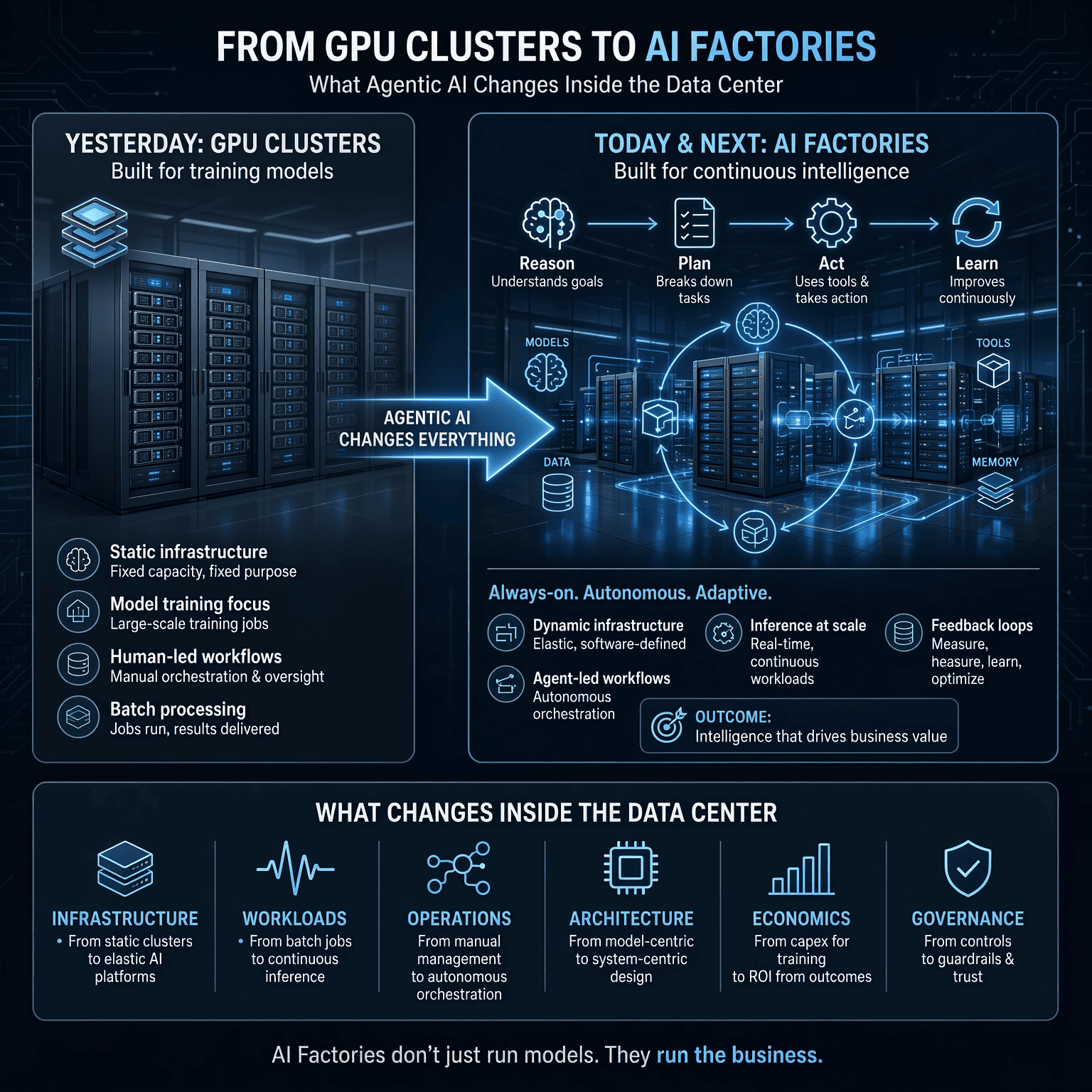
This means the race toward AGI is simultaneously a race to build the physical infrastructure capable of supporting increasingly autonomous systems.
That changes the geopolitical picture.
The country or company with the most capable model is not automatically the winner.
The decisive advantage may belong to whoever can combine models, compute, energy, capital, data and deployment at scale.
So, Did Sam Altman “Trick” the World?
Probably not in the simple sense implied by the headline.
There is not enough evidence to conclude that Altman deliberately invented a meaningless milestone and convinced everyone to believe it.
In fact, his own public writing contains significant caveats about what today’s systems can and cannot do. He has acknowledged uncertainty about the future and has explicitly noted that current AI-assisted self-improvement is not equivalent to a system autonomously rewriting its own code.
The more interesting criticism is different.
The AI industry may be operating with a definition of AGI that is broad enough to accommodate almost any future level of capability.
That does not make the technology fake.
It makes the milestone difficult to independently verify.
And those are two very different claims.
The Bigger Problem: We Need an AGI Standard
The industry does not necessarily need one perfect definition of AGI.
But it needs much clearer measurement.
A credible AGI evaluation framework could eventually examine several dimensions:
Generalization: Can the system solve genuinely unfamiliar problems?
Breadth: Can it perform across very different intellectual domains?
Autonomy: How long can it operate without human intervention?
Reliability: How often does it make serious errors?
Efficiency: How much computation and money does it require?
Transfer: Can knowledge learned in one domain improve performance in another?
Real-world usefulness: Can it reliably produce valuable outcomes outside controlled benchmarks?
A model that performs exceptionally well across these dimensions would provide a much stronger case for AGI than a corporate announcement ever could.
The AI Race Has Changed the Meaning of “Winning”
There is a strange irony in the current AGI competition.
The industry talks constantly about reaching the finish line.
But if nobody agrees where the finish line is, companies can keep running indefinitely.
Every new model becomes evidence that AGI is closer.
Every breakthrough becomes a reason to invest more.
Every investment produces more computing power.
More computing power enables more capable models.
And more capable models create even greater expectations.
That cycle could continue for years.
The real test, therefore, may not be whether OpenAI, Google, Anthropic or another laboratory announces AGI first.
It may be whether the industry can develop credible ways to measure progress before the economic and political consequences of those claims become larger than the science behind them.
The Bottom Line
GPT-6 Astra may represent a genuine leap in AI capability. The ARC Prize results show that it is capable of tackling difficult forms of unfamiliar reasoning, while also demonstrating why benchmark results need careful interpretation.
But saying “Astra is powerful” is not the same as saying “Astra is AGI.”
And saying “AGI has arrived” is not the same as proving it.
The most important lesson from the Astra controversy may therefore have nothing to do with Sam Altman personally.
It is that AI has reached a point where the ability to define technological milestones may be almost as valuable as the ability to reach them.
If AGI is real, we should eventually be able to demonstrate it.
Not because OpenAI says so.
Not because Nvidia says so.
Not because investors believe it.
But because an independent, reproducible standard shows that the system can do something fundamentally broader than the AI systems that came before it.
Until then, the most honest description of the current moment may be simpler:
We are getting much closer to the question—but we still haven’t agreed on the answer.

Independent technology writer focused on artificial intelligence, emerging technologies, and digital innovation. Covers AI applications in sports, productivity, and online business.