

































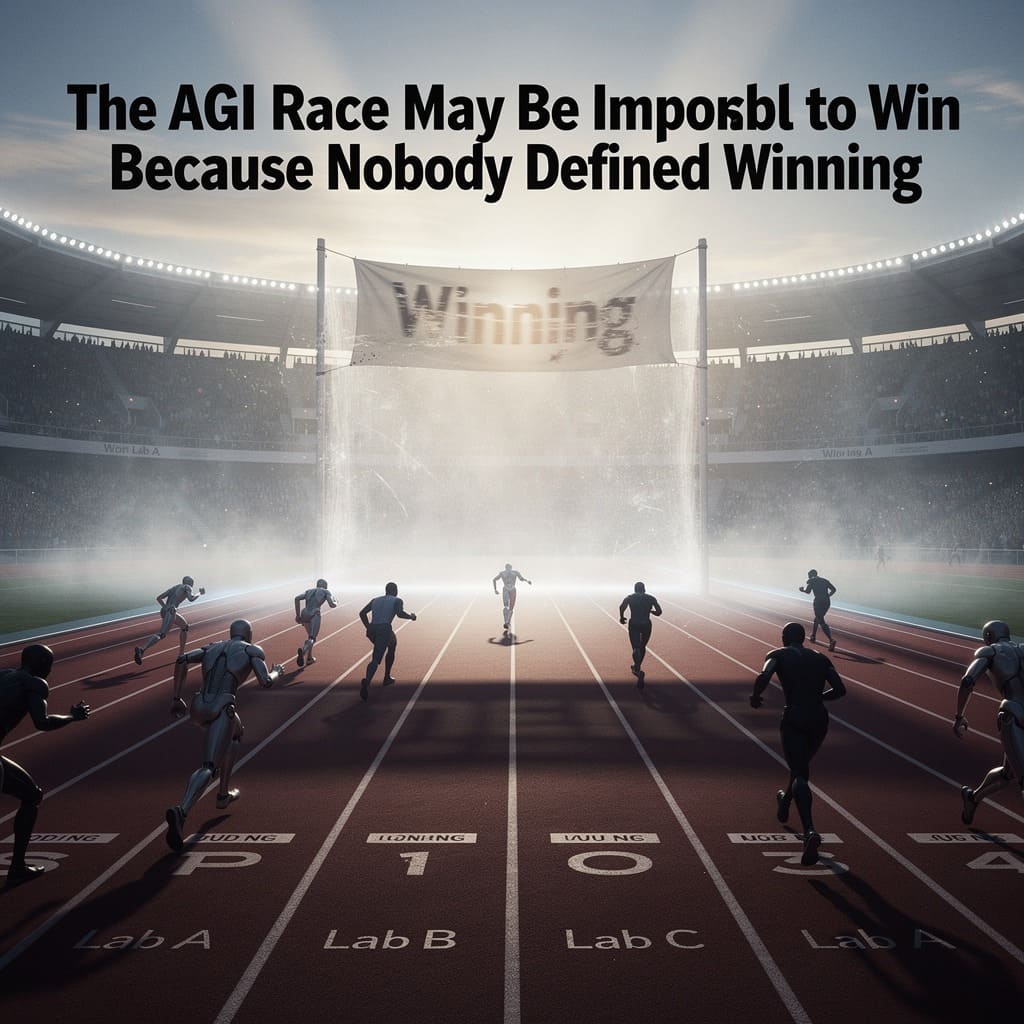
Every big race has a finish line. The AGI race is the strange exception. Thousands of billions of dollars are committed, governments are pulling together policy, and on September 6, 2026, Nvidia CEO Jensen Huang declared on social media that AGI has already arrived, crediting OpenAI’s GPT-6 Astra. By September 7, AI researcher Gary Marcus was pushing back, saying the declaration offered “no clear definition or evidence” for calling AGI achieved.
Both men can be right, and both can be wrong, because the phrase “AGI” is doing almost none of the work in that argument. Nobody defined winning. So the more useful question is not who leads the race, but whether a race with no agreed finish line can be won at all.
This article looks at the race from the side most coverage ignores: the definitions themselves, who controls them, and what the ambiguity does to capital, contracts, policy, and public trust. It is the strategic companion to the evaluation problem we covered in AGI May Have a Measurement Problem, Not an Intelligence Problem, and the follow-up to the GPT-6 Astra episode that brought all of this to a head.
A race needs a defined finish line
In sports, the finish line is physical. In markets, it is contractual. In engineering competitions like the X Prize, it is pre-registered and publicly verifiable. Races work because every competitor agrees, before the race starts, what counts as the end.
Apply that standard to AGI and the structure collapses. There is no neutral referee with an agreed rulebook. As the Financial Times, the Congressional Research Service, and the technologists themselves regularly note, there is no universally accepted definition of artificial general intelligence. What exists instead is a scattered collection of definitions, each owned by a different organization with a different incentive, each producing a different winner.
Consider the main competing definitions on the table in 2026:
| Definition | Who holds it | What counts as winning | Consequence if accepted |
|---|---|---|---|
| “Highly autonomous systems that outperform humans at most economically valuable work” | OpenAI charter (2018) | Broad but economically scoped performance | An economic bar, not a cognitive one |
| Generate $100 billion in profits | Reported internal OpenAI-Microsoft framework (The Information, Dec 2024) | A financial target, not a capability | AGI becomes an accounting event |
| Five-level AI scale: chatbot, reasoner, agent, innovator, organization | OpenAI (Bloomberg, July 2024) | Progress is gradual; no single “win” | AGI gets stretched into a staircase |
| Emerging to superhuman, with performance and generality axes | Google DeepMind’s “Levels of AGI” paper (arXiv, 2023) | A spectrum, not a threshold | No clean declaration moment |
| “Matching the cognitive versatility of a well-educated adult” | Academic frameworks (e.g., LawZero’s AGI score) | Quantified but contested metrics | AGI becomes a scoring exercise |
| “Do everything a human can do” | General public | Vague and moving | Almost by definition, never satisfied |
OpenAI’s charter line deserves attention, because it is the most quoted and the most elastic. “Outperforms humans at most economically valuable work” sounds precise until you try to measure it. Does a system that writes software at expert level but cannot book a meeting outperform “most economically valuable work”? Nobody has defined the denominator. That is not a measurement problem. It is a definition problem, and it predates any benchmark.
The most telling part of this inventory is who holds each definition. The winning definitions are not held by an independent scientific body. They are held by the companies that want to win. That is like letting the sprinters draw the finish line, and it has real consequences.
The goalposts keep moving by design
The moving target is not an accident of philosophy. It is a documented pattern in AI history, sometimes called the AI effect or Tesler’s theorem: AI is whatever humans can still do that machines cannot yet do. The moment a machine masters a task, the task gets reclassified as “not real intelligence.”
Chess took that path. When Deep Blue beat Garry Kasparov in 1997, the response was not “computers achieved intelligence.” It was “chess is mostly computation.” Translation beat chess in a similar cycle. Even the GPT-3 and ChatGPT moments followed the pattern, starting as proof of emergent intelligence and settling into “statistical pattern matching.” Each time, the definition retreated ahead of the capability.
The 2026 version of this cycle is playing out in real time. The GPT-6 Astra launch and the Altman-Huang “finish line” theater is the latest chapter. Huang says AGI arrived. Marcus says there is no evidence. Neither can lose the argument, because neither is arguing against a fixed definition. The claim “AGI has arrived” is unfalsifiable as long as “arrived” means whatever the speaker decides.
The deeper problem is structural, not rhetorical. When you can redefine the goal after each milestone, the race technically never ends, but the researchers and executives running it always claim progress. And since progress claims and capex commitments feed each other, there is an economic incentive to keep the goal fuzzy. That incentive is the thing most coverage misses.
What an undefined finish line does to the money
The AGI race is, in practice, the largest technology-driven investment boom in history, and observers at the Bank for International Settlements have said as much. U.S. hyperscalers spent roughly $420 billion on AI infrastructure in 2025. Projections for 2026 pass $1 trillion globally, with close to $600 billion in the United States. One investment manager estimates cumulative incremental AI capex from 2026 through 2030 near $7.5 trillion, roughly the combined GDP of Japan and France in 2025.
None of that money is being spent toward a defined finish line. It is being spent because the risk of being left behind is considered greater than the risk of overpaying, the logic we explored in why big tech fears extinction more than losses. OpenAI alone raised its projected infrastructure spending to $750 billion through 2030, about 25 percent above its earlier estimate, as the Wall Street Journal reported in July. Alphabet’s contracted future spending hit $811 billion at the end of Q2, up roughly $500 billion in a single quarter. Amazon expects about $200 billion in capex this year.
Notice what all those announcements share. None of them is tied to a definition of AGI. The commitments are tied to position. The prize is undefined, but the threat of falling behind is concrete, so the spending continues. That makes the AGI race a positional race, and a positional race with an undefined prize is efficient at one thing: escalation.
The financing is already feeling the strain. Bankers for OpenAI and Anthropic are pressing for investment-grade credit ratings ahead of their IPOs, and S&P Global Ratings analysts wrote last week that every time they look at the sector, capex is rising faster than anticipated, financings are more complicated and less transparent, and returns will take years to realize. That is what an undefined goal does to a balance sheet. You cannot model the return on a project whose completion condition is unspecified.
The leverage is in who declares the win
The ambiguity is not neutral. It concentrates power in the people who control the definition, and the most consequential fact about that power is written into OpenAI’s own structure.
OpenAI’s website has stated that its board determines when AGI has been attained, and that once attained, AGI is excluded from the IP licensing and commercial terms with Microsoft. In plain language: the moment the board says “we reached AGI,” Microsoft’s access to the crown jewels is cut off. As Fortune noted in 2024, the arrangement means OpenAI has a direct contractual incentive to define AGI in its own interest. A system the board would rather keep exclusive is AGI. A system that can be commercialized with Microsoft is something else.
The 2019 contract between OpenAI and Microsoft, made public in May 2026 during the Musk v. Altman trial, confirmed the stakes. The 36-page agreement defines AGI as “a highly autonomous system that outperforms humans at most economically valuable work,” the same phrase as the charter, but the trial brought the whole governance structure under public scrutiny. The definition is not just a philosophical stance. It is a contract term with binding financial consequences.
And there is a second, reported layer. The Information reported in December 2024 that OpenAI and Microsoft signed an agreement defining AGI as a system generating $100 billion in profits. OpenAI never confirmed that figure, and its public charter definition remains the capabilities one. But the existence of a financial definition alongside a capability definition shows the point perfectly: even inside a single partnership, “winning” has multiple, mutually incompatible meanings.
This is why the question of who declares AGI matters more than when. It is the mechanism by which “winning” gets decided, and right now each major lab is its own referee, its own rulebook, and its own scoring system. The governance vacuum that results is the subject we take up in who should control AI. You cannot audit a claim whose acceptance criteria were never published.
What this does to policy and public trust
Regulators face the same trap. You cannot write a law around a term that has no agreed definition, and the EU AI Act’s approach, which hinges threshold obligations on what counts as a high-impact general-purpose model, depends on definitions the very same model-makers influence. The EU AI Act Article 51 makes reference to systemic risk models without a settled, externally enforceable definition of the finish line. No regulator has the prize, so no regulator can police the finish line.
Public trust pays a different price. The Gallup survey published in May 2026 found that seven in ten Americans opposed AI data center construction in their area, with close to half strongly opposed. Anthropic’s IPO prospectus is expected to list that anti-AI backlash as a risk factor. When “we are close to AGI” has been declared repeatedly for years, and the definition keeps moving, the public reasonably concludes the whole thing is a marketing ladder. That skepticism, documented in the growing concern over AI, is itself a consequence of the undeclared race: people can smell a race with no finish line.
Even the people inside the labs cannot give a straight answer, and that is the honest state of things. In a TIME interview published at the end of August 2026, OpenAI’s chief research officer Mark Chen estimated the company was “80% of the way” to AGI. Greg Brockman said that viewed from two years in the future, this may be remembered as the moment AGI was created. Altman said OpenAI was “not quite yet” there, but that by the end of the year the company would have an internal system he would call AGI. Read those three statements together. They are not three people measuring the same distance. They are three definitions sharing the same word. The word is the only thing holding the race together.
What a winnable frame looks like
If the problem is that winning is undefined, the fix is not to argue harder. It is to make the definitional structure itself verifiable. A race becomes winnable when its finish line has three properties:
- Pre-registered. The definition is published before the race, not after the milestone.
- Third-party verifiable. The person claiming victory does not hold the measuring stick.
- Value-anchored. Winning is tied to measurable use, not to a board’s internal vote or a benchmark the lab designed itself.
The closest existing model is not a benchmark. It is the economic definition, if it were honest. “Outperforms humans at most economically valuable work” is a testable claim: you could pre-register a set of tasks, pay experts to score human and system outputs, and release the results before anyone declares victory. Nobody has done that, which is why the phrase remains marketing rather than measurement. The same logic that applies to evaluating AGI claims through measured benchmarks rather than vibes applies one level up: to the definitions those benchmarks are supposed to serve.
For anyone trying to evaluate a claim that “AGI has arrived,” the decision is simpler than it looks. Ask four questions:
- Who defined winning? If the claimant holds the definition, discount it.
- Was the definition public before the result? Post-hoc definitions are not definitions; they are rationalizations.
- Is there independent measurement? Claims scored by the lab that built the system are not evidence.
- What happens commercially if this is true? Follow who profits from declaring victory, and who profits from denying it.
By those four questions, Huang’s declaration fails on the same two grounds Marcus cited, definition and evidence, but that is not a knock on GPT-6 Astra specifically. The common sense gap persists regardless of model, and the tools we built to decide “is it smart yet” were never designed to answer “who gets to say so.”
The honest verdict
The AGI race may indeed be impossible to win, but not because the technology is inadequate. Races are won or lost against a defined standard, and the AGI era has refused, collectively and deliberately, to set one. Every party that could define the standard has an incentive not to: the labs want the mystique, the investors want the narrative, the hyperscalers want the capex, and the public has been told “it is close” for so long that any fixed definition would expose the gap between the story and the scoreboard.
That does not mean the money is wasted or the research is fake. It means the race as currently structured has a crucial design flaw. The finish line is wherever the loudest runner chooses to draw it after the fact. The follow-on question of who should control the process is not technical, it is political, and it will not be resolved by a better benchmark.
The AGI race is not unwinnable because nobody can reach the goal. It is unwinnable because nobody agreed where the goal is, and in a sport where the players draw the finish line, every checkered flag is a negotiation. The industry does not need a faster runner. It needs a referee.
Frequently asked questions
Has AGI already been achieved?
Claims differ. Jensen Huang said on September 6, 2026, that AGI has arrived, crediting GPT-6 Astra. Gary Marcus disputed the claim, noting the absence of a clear definition and evidence. OpenAI leaders give measured, internally inconsistent answers, from Mark Chen’s “80% of the way” to Sam Altman’s “end of the year.” There is no consensus, because there is no shared definition to measure against.
What is the official definition of AGI?
There is no universal official definition. OpenAI’s charter defines AGI as “highly autonomous systems that outperform humans at most economically valuable work.” A reported internal framework between OpenAI and Microsoft put the threshold at $100 billion in profits. Google DeepMind’s 2023 paper frames AGI as a spectrum from emerging to superhuman. None of these is used by all parties.
Why can’t researchers agree on AGI?
Partly because intelligence itself has no settled definition, and partly because an agreed definition would change commercial and regulatory outcomes. OpenAI’s board determines when AGI has been attained, and attaining it changes Microsoft’s access to OpenAI’s technology under their agreement. Definitions are stake-holders in that sense: they are contracts as much as concepts.
Could the race cause a bubble?
The spending is enormous, over $1 trillion projected globally in 2026 and roughly $7.5 trillion cumulative through 2030 by one estimate. Credit rating agencies have publicly flagged rising capex and slow returns. The absence of a defined outcome makes the return on this investment difficult to model, which historically increases bubble risk. It also means any “AGI achieved” moment could retroactively justify years of spending, which is exactly when such a declaration gets commercially convenient.
What would fix the race?
Turn the finish line from a private claim into a public, pre-registered, third-party-verifiable standard, economic or cognitive, agreed before any declaration. Until then, “AGI” will keep functioning as the finish line that every racer redraws after the race.

Independent technology writer focused on artificial intelligence, emerging technologies, and digital innovation. Covers AI applications in sports, productivity, and online business.