





































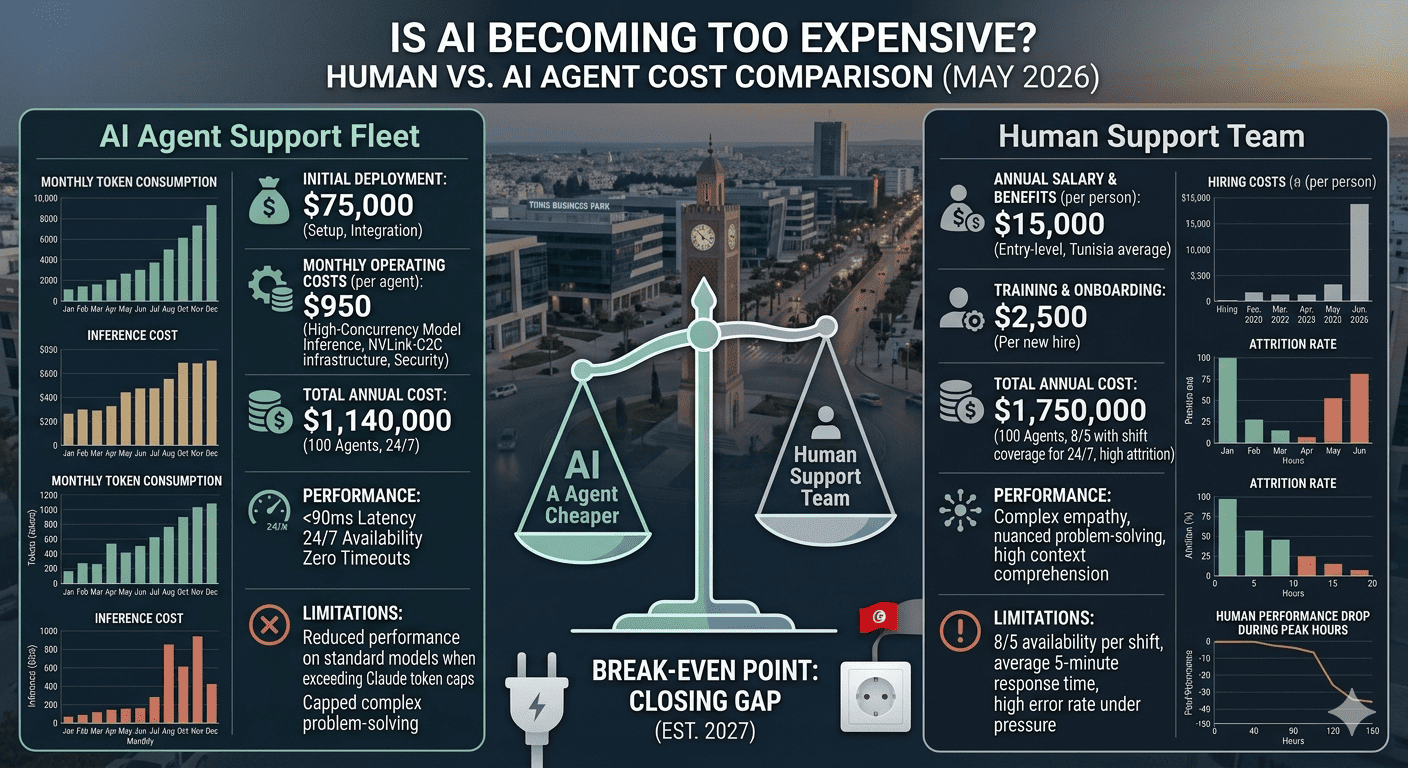
Published estimates for building one AI agent run from $15,000 to $9.75 million. The cheapest first agent on the board is $15,000 to $40,000 scoped at eight to twelve weeks; a 2026 cost guide puts a custom build at $20,000 to $120,000; a platform vendor’s total-cost-of-ownership model puts the same decision at $4.5 million to $9.75 million over three years for a single workflow. Three numbers, same word, fetched from the live pages on 6 October 2026 — and all three are vendor numbers with assumptions the buyer never sees.
Gartner’s stated reasons for cancelling agentic AI projects are escalating costs, unclear business value and inadequate risk controls: over 40% of those projects will be cancelled by the end of 2027. All three causes are settled before anyone writes code, in the moment someone accepts a cost model they cannot check.
So check it. Every line below resolves either to a source you can open or to arithmetic you can redo with four numbers of your own: your build hours, your quote, your seat count, your monthly run volume.
First, drop the false binary
You buy the model on both paths. Anthropic publishes its prices: Haiku 4.5 at $1 per million input tokens and $5 per million output, Sonnet 5.5 at $2 and $10, Opus 5.5 at $4 and $20. Build, and you buy the model by the token. Buy a product, and the vendor buys the model and resells it inside a subscription. The model is never the decision.
The decision is narrower than the phrase suggests: who owns the wiring — the integrations into your CRM, ERP, inbox and document store; the approval rules that decide what the agent may do without a human; the tests; and the maintenance after launch. Enterprise commentators now make the same point from the other side, splitting the choice into buy-embedded, buy-platform and compose rather than build or buy.
“Build” here means we write and maintain the wiring. It never means we train a model — and the step before this one, deciding whether a workflow needs an agent at all, is covered in what an AI agent actually is and when one is worth building.
The build side: hours, not a headline
The US Bureau of Labor Statistics reports a median annual wage of $135,980 for software developers in May 2025. The bottom tenth percentile earns less than $82,460; the top tenth earns more than $214,670.
Benefits are the line people forget. The BLS Employer Costs for Employee Compensation release for June 2026 data puts average private-industry compensation at $46.89 an hour: $32.82 in wages and $14.07 in benefits. Benefits are 30.0% of the total, wages 70.0%. Divide the total by the wage component and you get 1.43 — every dollar of salary costs about $1.43.
- $135,980 × 1.43 = $194,451 a year fully loaded
- $135,980 ÷ 2,080 hours = $65.38 in wages; × 1.43 = $93.49 an hour fully loaded
| Build hours | Loaded cost (rounded to $10) | What it looks like |
|---|---|---|
| 40 | $3,740 | one week of one engineer |
| 80 | $7,480 | two weeks |
| 160 | $14,960 | a month |
| 200 | $18,700 | roughly a five-week build |
| 1,000 | $93,490 | a quarter-scale integration project |
One claim in the search results sizes senior engineers at $200,000 to $300,000 fully loaded. Against BLS, the top-decile threshold is $214,670 × 1.43 = $306,978, so the claim sits in the right neighbourhood — but it describes the most expensive engineers in the distribution, not the median, and it is a claim about people rather than about a workflow.
Most first agents are not pricing a team. They are pricing a few hundred hours — and how many of those hours you need depends on who does the building, which is why non-technical employees are already assembling their own workflows without an engineering queue behind them.
One boundary on this section: it prices building against buying. The neighbouring decision — whether an agent is cheaper than hiring a person — is priced against the wage of the role being replaced, not against a developer’s.
The running side: prices that are on the page
An agent run has a computable cost. At Sonnet 5.5’s published rates, a run that reads 20,000 tokens and writes 2,000 costs $0.04 + $0.02 = $0.06.
| Runs per month | Model cost per month | Per run |
|---|---|---|
| 1,000 | $60 | $0.06 |
| 10,000 | $600 | $0.06 |
| 100,000 | $6,000 | $0.06 |
Assumption, stated so you can break it: 20,000 in and 2,000 out per run. Change the prompt length and change the column; the published per-million rates do not move. If your agent runs as a managed session instead of a bare API call, Anthropic charges $0.08 per session-hour on top, which is the line to watch when a run takes minutes rather than seconds.
Seats are a separate, optional line: Team plans are $20 per user per month billed annually or $25 billed monthly, and the plan is for “teams of 2 to 150” — so ten seats cost $2,400 a year on annual billing or $3,000 monthly. An API-only agent needs no seat at all. Whether a seat subscription earns its price for your workload is a calculation worth running on its own. Batch processing is the honest lever for non-urgent volume at half price.
The buy side: your quote, plus what the quote does not cover
Three real quotes for contract-review tooling, obtained for an earlier review on this site: $18,000, $22,000 and $42,000 in setup fees. The $42,000 quote adds $7,800 a month and $2.50 per page once a document set passes 50 pages.
| Quote of $42,000 | |
|---|---|
| Year one | $42,000 + ($7,800 × 12) = $135,600 |
| Year two | $93,600 |
| Two years | $229,200 |
| Overage risk | $2.50 per page above 50 pages — volume-dependent, unbounded |
This is an anecdote: three quotes, one category, one moment in time. It is not a market price. It is here because it is the only line on this page that came out of a vendor’s mouth to a buyer who was paying attention, and because the shape — setup fee, monthly floor, unit overage — is the shape to expect.
Published seat pricing behaves the same way with a floor attached, and vendor cost guides quote maintenance that appears only after launch: one worked example allocates $9,000 a year of maintenance to a $55,000 build, with year one totalling $78,000 to $85,000 and year two dropping to $19,000 to $26,000. Treat that as a vendor model, not a benchmark.
Where the two lines cross
Break-even is one division: your quote ÷ $93.49 an hour.
| Setup quote | Break-even in build hours |
|---|---|
| $18,000 | 193 hours |
| $22,000 | 235 hours |
| $42,000 | 449 hours |
Read the table from either side: below the break-even, building is cheaper than the quote — 200 hours cost $18,700, which clears an $18,000 quote and does not clear a $42,000 one. Above the break-even, the quote is cheaper than the same work.
Neither side stops at setup, so neither number should be compared alone. The build goes on running on tokens; the quote goes on running at $7,800 a month. One year of that monthly charge is $93,600 — about 1,001 hours of build work, every year, before the $42,000 setup fee is counted. The honest year-one comparison is build hours plus run cost against setup plus twelve monthly fees, and the honest year-two comparison is usage and upkeep against the monthly fee again. Price is then only the tie-breaker: what decides a close call is whether your engineers are actually free to spend the hours, and who owns the wiring in year two.
A build you own has a year-two cost of usage and upkeep. A quote you sign has a year-two cost of the quote. Both are real; only one of them is usually shown to you up front, and the costs that surface after launch have their own line items.
What the arithmetic cannot decide
Three inputs defeat any spreadsheet, and each is a question rather than a number.
Ownership after launch. Model prices change, APIs change, and an agent’s behaviour drifts as the documents and tickets it reads change. Who absorbs that — and at what price — is a contract term, not an arithmetic result.
Integration span and data sensitivity. A workflow that lives inside one suite is a different purchase from one that reads and writes across CRM, ERP and inbox. The vendor frameworks in the search results converge on this: one published scorecard makes the three-year run cost its fifth criterion and calls it buy below $25,000 a year, build once off-the-shelf at scale passes $40,000 a year. That is a vendor’s framework with a vendor’s thresholds, useful as a prompt and not as proof.
Whether your hours are free. An hour a developer spends on this is an hour not spent elsewhere. The vendor models all keep a row for opportunity cost and label it “significant” without a number; you are the only one who can price it.
There is also the question of what you are buying at all. Gartner, in the same June 2025 release, describes “agent washing” — the rebranding of assistants, RPA and chatbots as agentic — and estimates that only about 130 of the thousands of agentic AI vendors are real. A January 2025 Gartner poll of 3,412 webinar attendees found 19% had made significant investments in agentic AI, 42% conservative investments, 8% none, and 31% were waiting or unsure.
Five questions before you sign
If you are still choosing between products rather than between routes, score the tool itself before you score its price. Then ask every vendor:
- Show me the token assumptions in your TCO model. One published model says its ranges “reflect the default assumptions in our TCO model”. Defaults are not your volume.
- What is the overage schedule, in writing? Seats, tasks, pages, resolutions — each one is a unit price, and units grow.
- Who owns maintenance after month three, and what does it cost?
- What is the exit path? Can your prompts, data and audit trail leave with you?
- What does this cost at ten times the volume? Take their number, take your run count, and re-run it against published per-million token prices.
What we do not know
Vendor TCO models are unpublished beyond their headline ranges, so their assumptions cannot be audited — only their conclusions compared. Maintenance rates appear in this piece only as vendor assertions, from a vendor. The three quotes are three, in one category. And search demand for this topic on this site is unknown: there is no query data in the repository, so nothing here claims volume, position or traffic.
Take four numbers into your next budget conversation: hours, quote, seats, runs. An estimate that will not show its assumptions is not an estimate.
Sources (all fetched 6 October 2026 unless noted)
- US Bureau of Labor Statistics, Occupational Outlook Handbook: Software Developers, Quality Assurance Analysts, and Testers — median annual wage $135,980, May 2025 wage data; page last modified 27 August 2026. https://www.bls.gov/ooh/computer-and-information-technology/software-developers.htm
- US Bureau of Labor Statistics, Employer Costs for Employee Compensation, June 2026 data, released 9 September 2026 — $32.82 wages, $14.07 benefits, $46.89 total per hour, private industry.
- Anthropic pricing — input/output rates by model, managed agent session-hour rate, Team plan seat pricing and the “teams of 2 to 150” term. https://www.anthropic.com/pricing
- Gartner, Gartner Predicts Over 40% of Agentic AI Projects Will Be Canceled by End of 2027, press release, Sydney, 25 June 2025. https://www.gartner.com/en/newsroom/press-releases/2025-06-25-gartner-predicts-over-40-percent-of-agentic-ai-projects-will-be-canceled-by-end-of-2027
- Arkeo AI, Custom AI Agents Solutions: Build vs Buy, 9 June 2026 (updated June 2026) — $15,000–$40,000 scoped build, $20–$30 per user per month, five-criterion scorecard. VENDOR MODEL. https://www.arkeoai.com/ai-in-business/custom-ai-agents-solutions
- AGI Software Solutions, What an AI Agent Actually Costs in 2026, 3 August 2026 — $20,000–$120,000 build, $500–$5,000 a month to run, worked year one $78,000–$85,000. VENDOR MODEL. https://agisoftwaresolutions.com/blogs/ai-agent-cost-2026.html
- MightyBot, Build vs Buy AI Agent Platform: Cost & TCO — $1.7M–$3.75M year one, $4.5M–$9.75M three-year for a single workflow, “default assumptions in our TCO model”. VENDOR MODEL. https://mightybot.ai/why-mightybot/build-vs-buy
- Three vendor quotes for contract-review tooling: $18,000 / $22,000 / $42,000 setup, $7,800 a month, $2.50 per page above 50 pages. ANECDOTE, confirmed by the author, 6 October 2026.

Independent technology writer focused on artificial intelligence, emerging technologies, and digital innovation. Covers AI applications in sports, productivity, and online business.