

























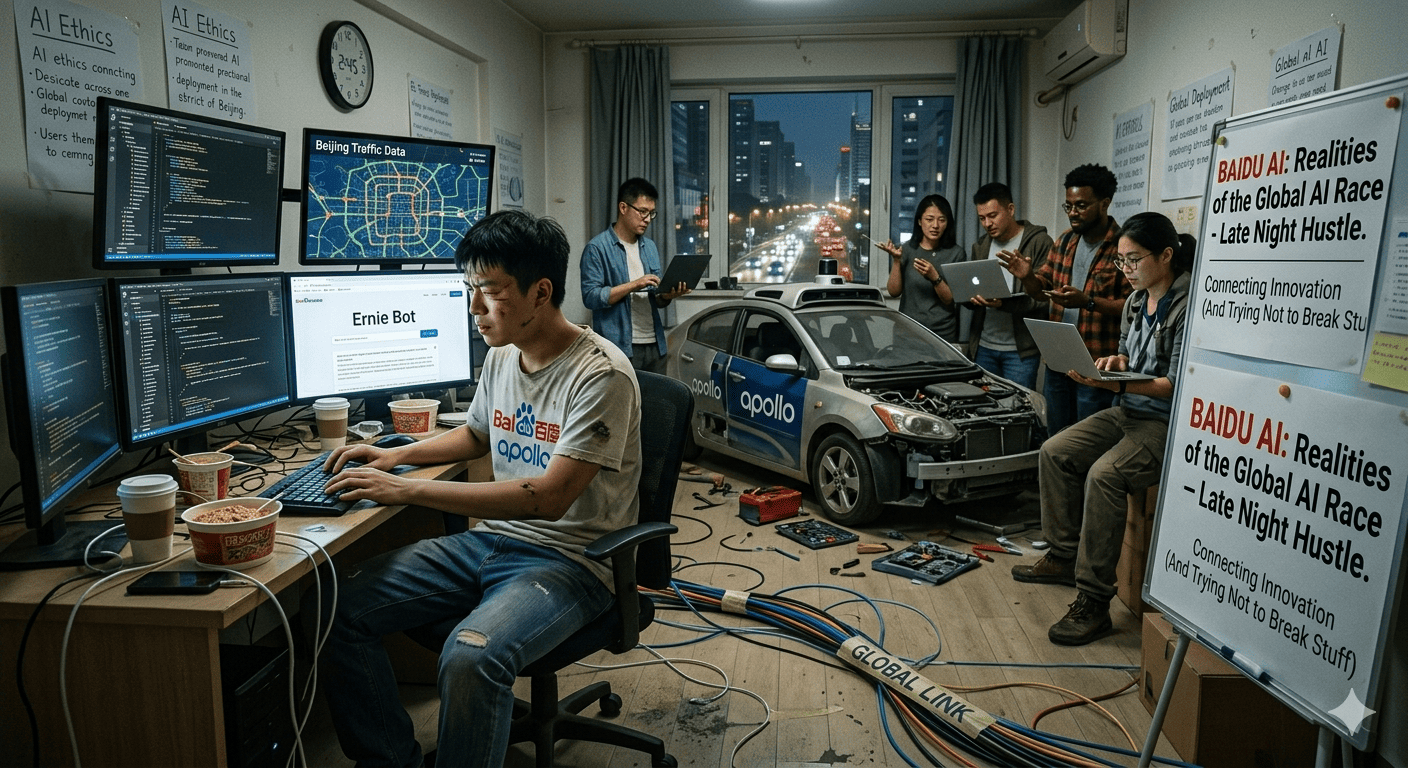
When people talk about the global AI race, they usually mention OpenAI, Google, and Microsoft. But in China, Baidu has been working on artificial intelligence since before ChatGPT existed. The company was working on AI before it became a buzzword. Today, Baidu AI powers everything from search results to robotaxis. This article explores where Baidu stands in the global artificial intelligence race and whether it can compete beyond China’s borders.
Baidu’s AI Foundations
From search engine to AI company
Baidu started as a search engine in 2000, much like Google. But around 2013, the company made a deliberate shift toward AI. It opened the Baidu Research lab in Silicon Valley and hired leading AI researchers. By 2016, Baidu had published more deep learning papers than most Western tech companies. The strategy was simple: search is an AI problem, and whoever solves AI best will own search. That bet shaped everything Baidu built afterward.
Baidu Research and deep learning roots
Baidu’s research division focuses on computer vision, speech recognition, natural language processing, and knowledge graphs. Its deep learning framework PaddlePaddle is one of the most popular AI platforms in China. PaddlePaddle competes directly with TensorFlow and PyTorch, though it has less adoption outside China. Baidu AI research has produced breakthroughs in voice cloning, language understanding, and autonomous driving. The company holds thousands of AI patents and publishes regularly in top conferences.
The Chinese AI Ecosystem
Baidu within China’s tech landscape
Baidu is one of China’s “BAT” trio — Baidu, Alibaba, and Tencent. Each has its own AI strategy. Alibaba focuses on cloud AI and e-commerce. Tencent focuses on social AI and gaming. Baidu focuses on search AI, autonomous driving, and language models. This specialisation makes Baidu the closest Chinese equivalent to Google’s AI efforts. If you want to understand how Chinese AI companies compete globally, Baidu is the best case study. For more on how Chinese tech giants challenge American dominance, see our comparison of Alibaba vs Nvidia in the AI chip war.
Government backing and regulation
Baidu operates within China’s strict AI regulatory framework. The government requires approval for large language models and enforces content safety rules. This limits what Baidu can say or show but also provides funding and policy support. Baidu was one of the first companies approved to launch a public LLM in China. The result is a trade-off: less freedom, more support. For Baidu artificial intelligence, this has been both a restriction and an advantage.
Ernie Bot — Baidu’s Answer to ChatGPT
Capabilities and integration
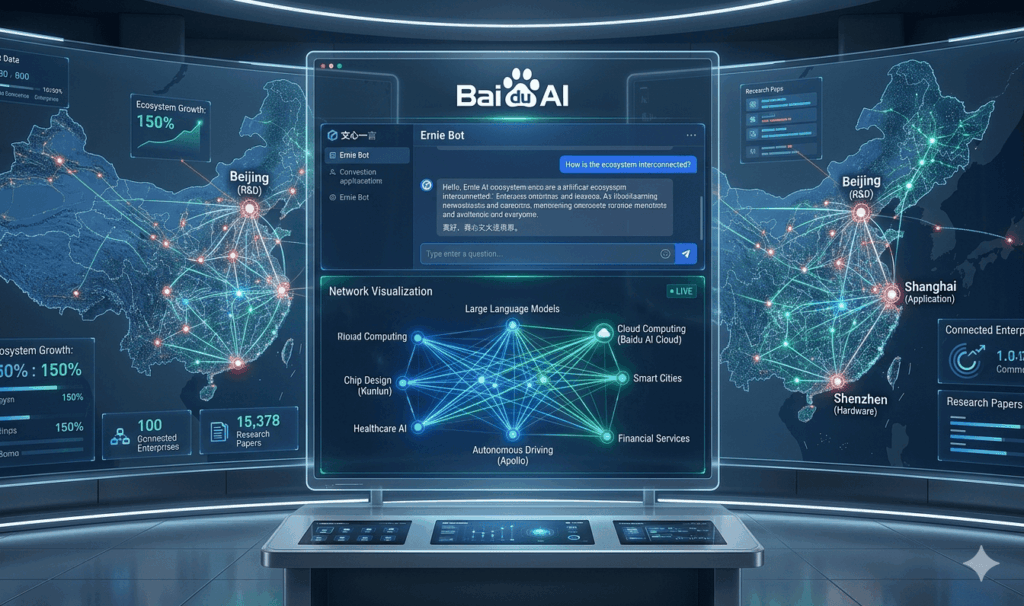
Ernie Bot (文心一言) is Baidu’s large language model. It can write, summarize, translate, and answer questions in Chinese and English. It is integrated into Baidu Search, Baidu Cloud, and smart speaker products. Ernie Bot handles Chinese idioms, cultural references, and local regulations better than any Western model. On Chinese language tasks, it often outperforms GPT-4. For a broader look at how different AI chatbots compare, check our detailed comparison of ChatGPT vs Claude vs DeepSeek.
How it compares to Western models
On global benchmarks like MMLU, Ernie Bot trails behind GPT-4 and Gemini. But benchmarks do not tell the full story. Ernie Bot is optimized for the Chinese internet, where content policies, user behavior, and language are different. In practical terms, it answers Chinese user questions more accurately than any Western model can. The gap in raw capability exists, but for China’s market, Ernie Bot is competitive. Baidu AI strategy does not aim to beat GPT-4 on English tests. It aims to dominate the Chinese-speaking AI market, which is the largest internet market in the world.
Baidu’s Global AI Ambitions
Cloud and enterprise AI
Baidu Cloud offers AI services for Chinese enterprises, including computer vision APIs, NLP tools, and custom model training. These services compete with Alibaba Cloud and Tencent Cloud domestically. Outside China, Baidu Cloud is not widely available. The company has partnered with some Southeast Asian businesses, but its global cloud presence is small. This is one area where the global AI race Baidu participates in looks very different from the one Western companies face. For context on the broader AI arms race between US and Chinese tech, see our article on why the United States is concerned about low-cost Chinese AI.
Open source contributions
PaddlePaddle, Baidu’s deep learning framework, is open source. It has over 50,000 stars on GitHub and an active community — mostly in China. Baidu also open sourced several pre-trained models and datasets. However, the global AI community mainly uses PyTorch and TensorFlow. Baidu’s open source influence is growing but remains regional. This limits the Baidu AI ecosystem’s reach outside China.
Challenges and limitations
Baidu faces three major barriers to global AI relevance. First, US export controls restrict access to advanced Nvidia chips, which Baidu needs for training large models. Second, Western trust in Chinese AI companies is low due to data privacy and censorship concerns. Third, Baidu’s products are designed for Chinese users and do not translate well to global markets. Chinese AI startups are feeling this chip shortage pressure acutely, as we covered in our analysis of how surging Nvidia B300 prices are crushing Chinese AI startups.
Conclusion
Baidu plays a bigger role in the global AI race than most Western observers realize. It has strong research, a capable LLM, and a clear strategy. But its influence is mostly contained within China. Baidu artificial intelligence will likely remain the dominant AI provider in China while playing a supporting role globally. That still makes it one of the most important AI companies in the world — even if you never use its products. The Baidu AI story is a reminder that there is not one global AI race. There are two: one inside China, and one everywhere else.
Frequently Asked Questions
Is Baidu leading China’s AI race?
Baidu is one of the leading AI companies in China, alongside Alibaba and Tencent. It plays a major role in search-based AI, large language models, and autonomous driving. However, the Chinese AI landscape is highly competitive, and leadership depends on the specific area—cloud AI, consumer AI, or enterprise solutions.
How does Ernie Bot compare to ChatGPT?
Ernie Bot is Baidu’s large language model and is optimized primarily for Chinese language tasks and local internet content. ChatGPT, on the other hand, has broader global training data and stronger performance across multiple languages and reasoning benchmarks. Ernie Bot tends to perform better in Chinese-specific contexts, while ChatGPT is generally stronger in global versatility and complex reasoning tasks.
Why is Baidu restricted outside China?
Baidu faces limited global expansion due to several factors, including regulatory differences, data privacy concerns, and geopolitical restrictions. Additionally, many of its products are designed specifically for the Chinese ecosystem, making international adoption more difficult compared to Western AI platforms.
What is PaddlePaddle used for?
PaddlePaddle is Baidu’s open-source deep learning framework. It is used for building, training, and deploying AI models in areas such as computer vision, natural language processing, and speech recognition. It is widely used in China’s AI ecosystem and serves as an alternative to frameworks like TensorFlow and
Sources and Context
- Baidu AI official announcements
- PaddlePaddle documentation
- Stanford / AI research references
- Industry reports (McKinsey / Gartner

Independent technology writer focused on artificial intelligence, emerging technologies, and digital innovation. Covers AI applications in sports, productivity, and online business.