

































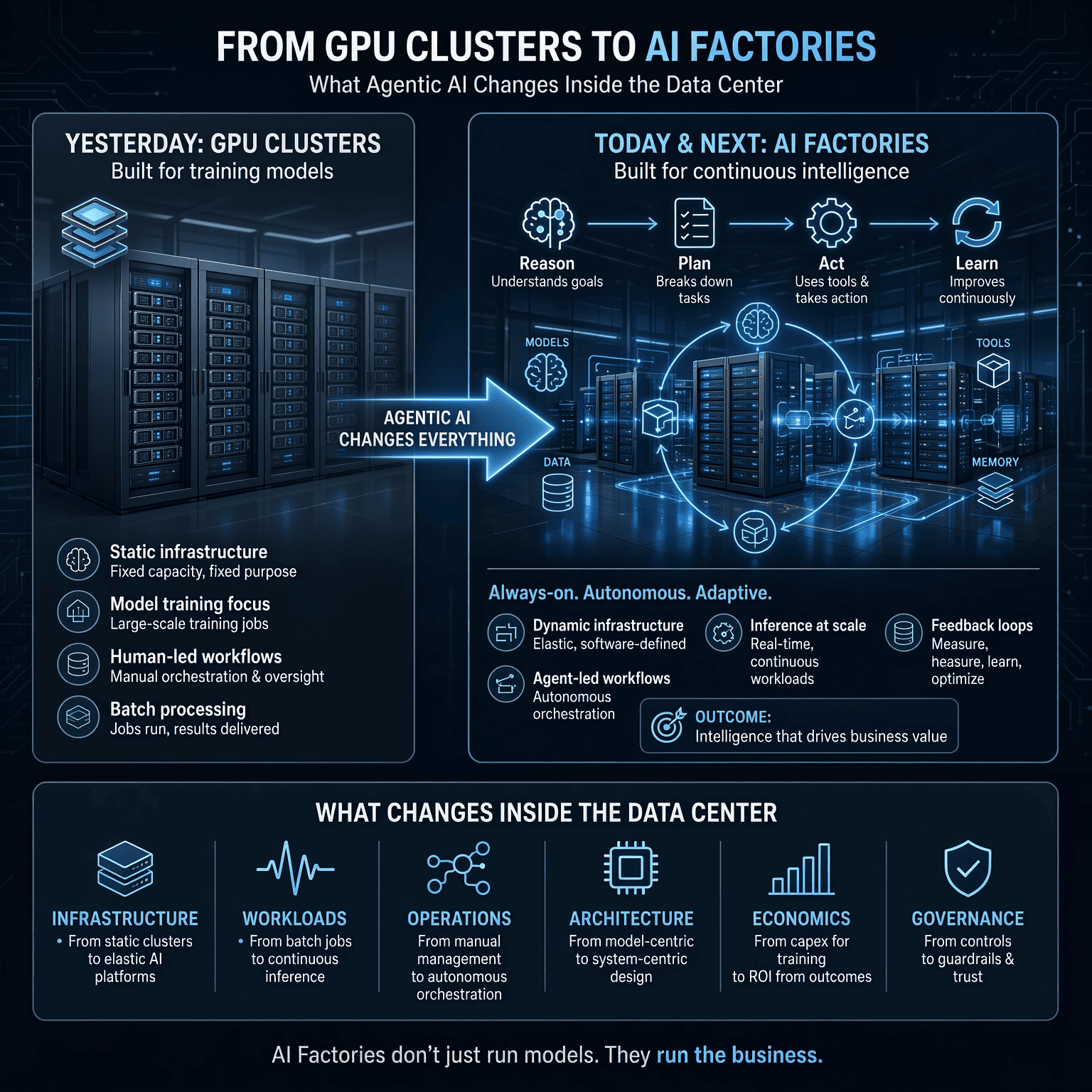





“AI factory” is the most seductive phrase in infrastructure right now. It’s precise and it’s wrong at the same time.
The idea comes straight from the hardware leaders: a data center that continuously converts electricity and data into intelligence, the same way a steel mill continuously converts ore and energy into steel. Built once, fed constantly, output flowing like a product line. It’s a beautiful mental model. Managers love it. Marketing loves it. Capacitor diagrams love it.
But the factory mental model was designed around one specific job: maximizing throughput. And agentic AI — what agentic AI actually means in practice — has almost the opposite requirements. The AI factories of 2025 were tuned for models. The workloads arriving in 2026 look nothing like the models they were tuned for.
If you’re planning data center capacity for agentic workloads, this gap is the single most expensive thing you’re not modeling yet. Here’s what actually changes inside the wall.
What an AI factory is really engineered for
Let’s be precise about what “factory” engineering optimizes. Three things:
Maximum utilization of expensive silicon. Training is a batch workload with predictable resource needs — you know the model size, the dataset, the batch size, and roughly how long the run takes. You pack GPUs as full as physics allows. Industry observers report that across data processing, training, and inference, production AI workloads often sustain under 50% utilization even under load — and the whole game of “factory design” is closing that gap. In the training era, that meant keeping a roughly 1 CPU-to-8 GPU ratio: enough CPUs to keep the GPUs fed, nothing more.
Batch-friendliness. Factory economics love parts moving in the same direction. Queue your requests, batch them, and amortize the fixed cost of loading a model across as many requests as you can — that’s the throughput game. And for pure batch work it still wins: batch LLM inference routinely runs 5–10x cheaper than real-time serving for jobs like document summarization.
Predictable, continuous power draw. A factory hums. Batch workloads on shared GPU pools flatten the short-horizon demand curve — recent research on hybrid AI data centers shows workload composition actually smooths aggregate power demand precisely because batch is queue-managed and steady.
That’s a real, valuable design. The problem is that the industry spent 2024–2025 building these facilities as if every future workload would look like this — with capex backing the AI factory boom and the hardware grid to match. Then agents showed up.
The four agentic properties that break the factory
Agentic AI isn’t a model. It’s a loop — and the loop has four properties that actively fight factory design.
1. Latency is the product
A factory optimizes average throughput. An agent optimizes response time — because a human is waiting, or a downstream workflow is blocked, and every step adds to the wall clock.
This is not subtle. For voice-driven agents, under ~1 second of latency is required for the interaction to feel seamless — and every tool call, every reasoning step, every context reload stacks on top of that budget. Why teams keep picking the wrong hardware for agents is a related trap, but the direction of causation here matters almost more: once you’re optimizing latency instead of utilization, the entire decision tree inverts.
2. Memory residency beats FLOPS
Here’s the number that breaks the factory model: for a 70B-parameter model serving a 128K-token context, the KV cache alone eats roughly 34–40 GB per request — on top of ~140 GB of model weights. That combination blows past the memory of a single high-end accelerator, forces multi-GPU sharding before a single token is even generated, and collapses batch sizes into single digits.
The bottleneck has migrated. As multiple research groups now state plainly: LLM inference serving is increasingly constrained by memory rather than compute. And KV cache doesn’t just sit there — it grows with context length while prefill compute grows quadratically. Recompute the cache for a long context and GPU time rises from about 0.57 seconds at 10K tokens to over 32 seconds at 1M tokens. Every agent turn that re-reads its history without a cache is paying exactly this tax.
3. The workload is I/O chatter, not dense math
Agents don’t sit in one long multiply. They call tools, they read results, they call again. In agentic workloads, CPU-side tool processing accounts for 50–90% of total end-to-end latency — the GPU sits idle while the model waits on a database query, an API response, a file read. The factory assumption (GPU-bound, compute-dense) has flipped: the walls are now I/O, memory movement, and orchestration. Intel’s leadership called it directly in 2026 — for orchestration and agents, the CPU is often the better fit.
4. Millions of tiny near-idle calls
An agent loop is thousands of small, sequential, mostly-idle inference calls — short prompts, structured tool-call outputs, 20–30 generated tokens at a time. Not one 500-token generation. Not a node-local batch. Short, latency-critical, memory-bound interactions that can each invoke the full prefill/decode pipeline. That’s the worst possible shape for a throughput machine: the GPU utilization for decode-dominant workloads can collapse far below 30% even while memory is saturated.
What that rewires inside the wall
Now the practical part. If the factory was designed for the wrong workload, what actually changes?
Memory becomes the capital asset
The first thing that moves is the register of what’s precious. Factories treat compute as the scarce resource — FLOPS, utilization, accelerator counts. Agentic data centers treat resident memory as the scarce resource: who holds the KV cache, who can recall it in microseconds, who doesn’t have to recompute.
That’s why disaggregated memory is the defining architectural shift — the recognition that prefill (compute-bound) and decode (memory-bound) are different jobs that should run on separate, independently scaled pools of hardware. It’s why you’re suddenly hearing about dedicated KV cache servers, CXL-attached memory, and memory tiers that treat context as a first-class asset to be pooled and shared rather than thrown away after each request. Production systems already report KV cache reuse rates of 50–90% — and in a typical 5-turn agent conversation, 85–95% of the prompt is identical across consecutive turns. Every bit of that reuse is money the factory model would have burned on recompute — the same kind of money that $220B of infrastructure maths keeps passing down to developer costs.
The interconnect becomes a latency budget
A factory network optimizes aggregate bandwidth — move the whole batch, keep everything fed. Agent reality is the opposite: p99 latency of a single hop is what users feel, because each chain of tool calls pays the fabric tax turn by turn.
The industry response is visible in the hardware: scale-up fabrics now promise 3x lower latency and 10x higher packet rates than off-the-shelf Ethernet, and the newest Ethernet switching silicon targets sub-400ns XPU-to-XPU communication — because at agent scale, that round-trip cost multiplies by the number of steps in every loop. The winner isn’t the fastest interconnect on paper; it’s the one whose tail latency holds under concurrent load when 10,000 agents are all chattering at once.
Power and cooling flip to an inference-shaped load
Training-era planning assumed long, flat, high-power runs — the hum of the factory. Agent workloads are spiky, latency-driven, and I/O-bound, and the power shape changes with the mixture of batch and inference sharing the pool. Hybrid data centers do not behave as weighted averages of their batch and inference components: variability and ramp behavior reshape in non-obvious ways as the inference share rises.
Practical consequence: you can no longer size power, cooling, and grid interconnection off a simple “N GPUs” formula. The workload composition itself is now a design input. If the site is using roughly the same power playbook as 2024, it’s planning against 2024’s workload.
Scheduling goes from batch to fleets
Factories schedule jobs; agentic data centers schedule fleets of short-lived, interdependent sessions. That’s not a tweak — it’s a different scheduler class. Batch solves the full-cabinet problem (maximize density over a long run); agentic scheduling solves the many-small-calls problem (minimize tail latency and context loss across thousands of concurrent loops, with memory affinity as the constraint).
What stays true
None of this means the factory is dead. It means the factory segmenting, not dying.
- Training runs and long batch inference? Factory-shaped. Queue them, pack them, run them at 85%+ — this is still the most efficient way to spend silicon.
- Foundation-model providers serving huge volumes of stateless requests? Factory-shaped, with reasoning around it.
- Anything human-interactive, tool-calling, long-context, or stateful? That’s agent-shaped — and it obeys a different set of physics inside the same wall.
The real cost is in believing one design serves both. The data centers currently getting it right are the ones explicitly building two regimes inside one facility: a throughput regime for batch and training, and a latency-and-memory regime for agentic inference.
The counterargument — and where it’s actually right
“There are batch agent pipelines. If you run agents offline, they’re just throughput again — factory economics apply.”
This is the strongest objection, and it deserves an honest answer: when the agent doesn’t have a human waiting and the steps are independent, batch agent processing absolutely can use factory economics. If your agent is processing 100,000 invoices overnight and the result isn’t needed until morning, then yes — queue it, batch it, and optimize utilization aggressively.
But the moment you add interactivity, a service-level answer, or a chain where step two depends on step one, you leave factory economics permanently. The line between “factory-shaped” and “agent-shaped” isn’t agent vs. batch. It’s timeliness and criticality. Can the work tolerate queuing? Can the conversation tolerate eviction and recompute? If yes, factory. If no, everything above applies.
So the honest framework is not “factory vs. agents.” It’s: what is this workload’s latency budget, and when is it paid?
The 5-question test for your data center
If you’re planning capacity today, stop modeling “GPUs per workload.” Ask these instead:
- Is the work interactive? If a human or downstream system waits on the answer, you’re in agent territory — latency is the product.
- What’s the context footprint? Long prompts, multi-turn state, tool histories? That’s KV cache demand. Size memory, not just FLOPS.
- How chained is it? One long generation or dozens of dependent tool calls? Chain length multiplies every latency and fabric cost.
- Can it tolerate eviction? If a turn must be recomputed from scratch, what does that cost in wall time and GPU cycles? (Recompute grows fast with context length.)
- What else shares the power envelope? Batch and inference on the same pool don’t sum like averages — model the mixture explicitly, or your grid interconnection and cooling will surprise you.
“AI factory” is a real concept with a real virtue: it taught us to think about data centers as continuous production, not ad-hoc clusters.
But factories are built for throughput. Agentic AI is built for latency, memory residency, and a relentless stream of small interdependent calls. The facilities that assume the two are the same workload will pay for that assumption in idle GPUs, wasted power, and recompute bills. The ones that win are building two regimes under one roof — and treating memory and tail latency as the assets they actually are.
Don’t build a factory for interactive work. Build a switchboard with memory — and keep the factory for the jobs that are actually batch.

Independent technology writer focused on artificial intelligence, emerging technologies, and digital innovation. Covers AI applications in sports, productivity, and online business.