






















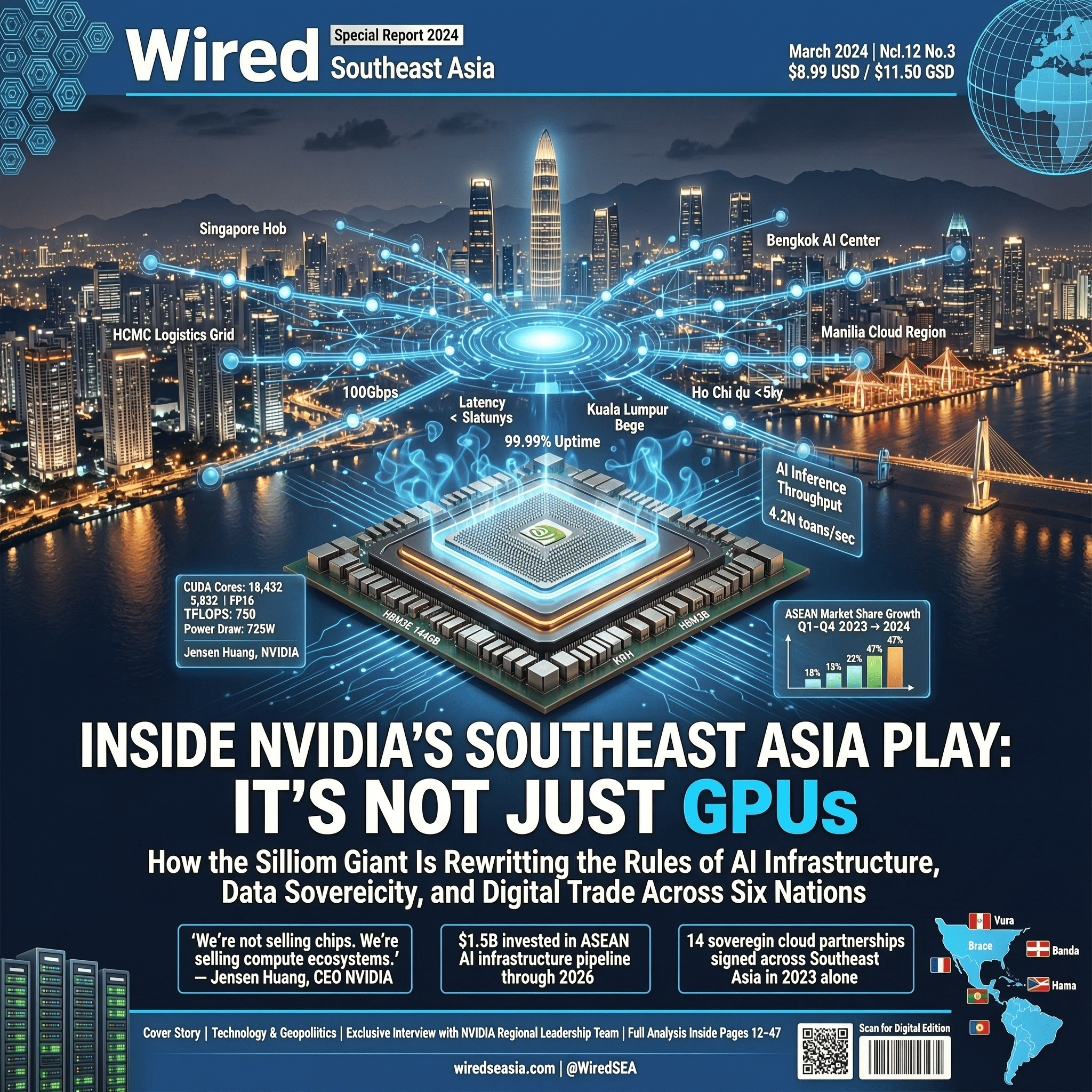



While the world watches NVIDIA’s GPU shipments, the company is quietly engineering Southeast Asia’s entire AI stack — and it is a much bigger bet than selling chips. In twelve months it anchored a research hub in Singapore, signed up for a gigawatt-scale AI factory in Indonesia, seeded its open Nemotron models into six national languages, made Singapore’s Home Team and Sea Limited early references for its next hardware generation, and tied its strategy to the US export-control system that decides which countries get advanced compute at all. The pattern is consistent: NVIDIA is not waiting for Southeast Asia to buy GPUs. It is building the infrastructure, the models, the research, and the policy tailwind that make buying NVIDIA the only easy choice. The chips are the toll booth. The territory on the other side is the prize.
The toll booth thesis
Start with the numbers that frame the whole story. NVIDIA holds roughly 90 percent of the AI accelerator spending market, and Asian suppliers now represent roughly 90 percent of its production costs — up from about 65 percent a year earlier, covering TSMC fabrication, SK Hynix and Samsung HBM memory, and Foxconn and Quanta assembly. Southeast Asia, into which Microsoft, Google, Amazon, and OpenAI are all pouring datacenter money, is the world’s fastest-growing regional AI infrastructure market, and its demand is now organized, government-funded, and increasingly titled “sovereign AI.”
Chips alone would be simple. But NVIDIA is doing something else in the region, and it breaks down into four moves that compound into one.
Move 1: Selling AI factories, not accelerators
The clearest signal is Zankore, the Indonesian AI-infrastructure venture announced in Jakarta on August 7, 2026, by Indosat Ooredoo Hutchison, Ooredoo Group, Nokia, and NVIDIA. The headline is a gigawatt: 1 GW of AI computing capacity within three years. The first phase — the number that is actually committed — is about 200 MW at Batang, Central Java, with construction beginning in the first half of 2027, built around NVIDIA GB300 NVL72 on NVIDIA’s DSX reference architecture.
DSX is the tell. It is not a chip; it is NVIDIA’s “playbook” for designing and operating an AI factory, bundling accelerated compute, networking, power, cooling, and operations into one system. Its MaxLPS component dynamically reallocates power across the GPU fleet to reclaim stranded power — NVIDIA claims up to 40 percent more compute inside the same facility power envelope. The roles in the consortium are equally telling: Ooredoo Group is the long-term capital and platform sponsor; Indosat supplies the market and execution; Nokia supplies AI-native networking; NVIDIA supplies the compute, the software stack, and the ecosystem. The partners deliberately published no total investment figure — the ~US$50 million-per-megawatt figure is the minister’s, not the consortium’s, so treat anyone’s $50 billion multiplication as arithmetic, not an announcement.
Indonesia’s Communications and Digital Affairs Minister Meutya Hafid made the government’s logic explicit: “Indonesia has the potential to serve not only its own needs, but also the broader region… we can accelerate the development of a sovereign AI infrastructure that benefits both businesses and society.” For a single-generation comparison: Singapore, still Southeast Asia’s largest datacenter market, runs on roughly 1.46 GW of live capacity built over two decades. Indonesia is proposing a workload with two-thirds of that scale in three years.
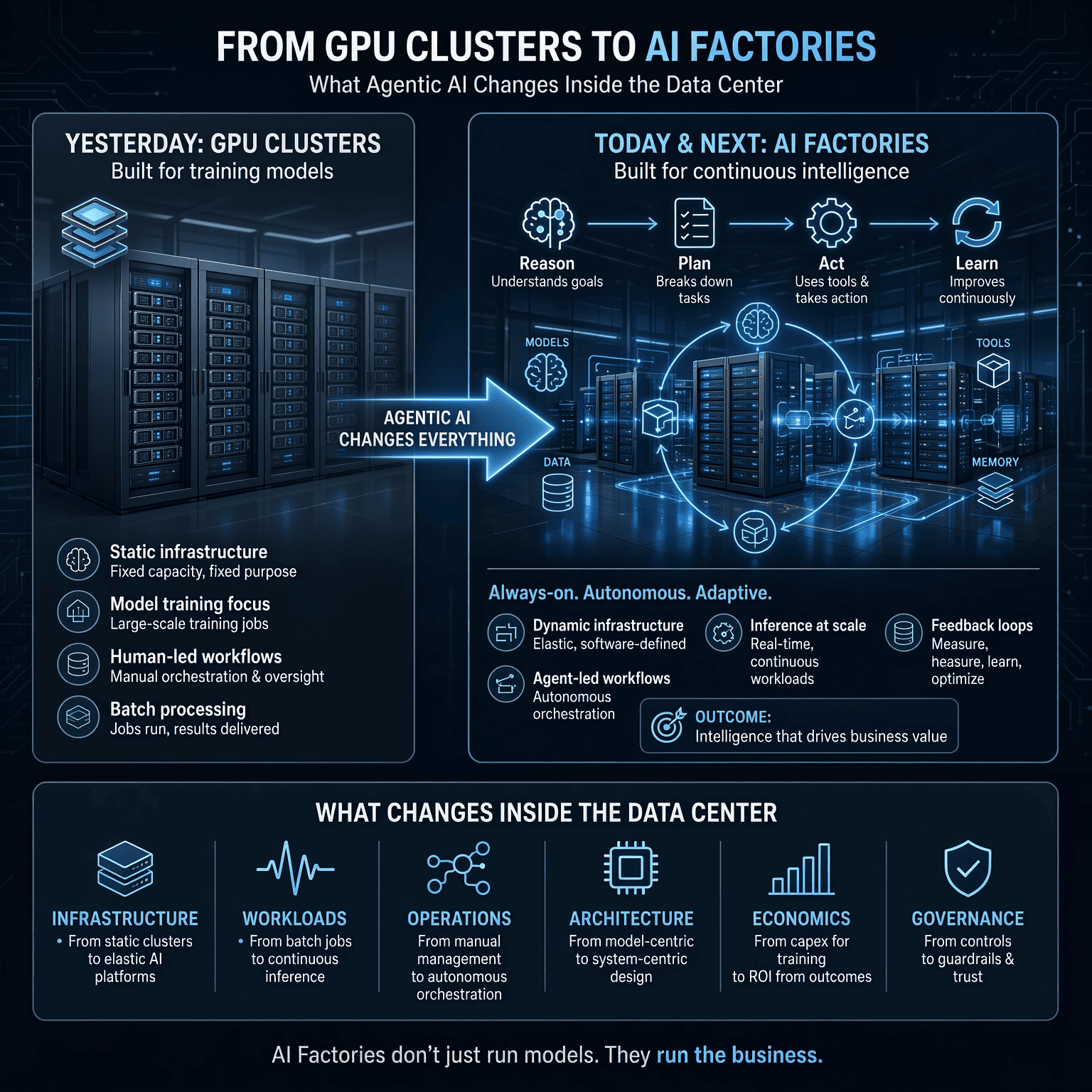
This is the AI-factory shift this site has described, rendered at national scale: the GPU is inside a package of power, cooling, networking, and operations that NVIDIA increasingly orchestrates end to end.
Move 2: Models as the moat — give the models away, sell the toll
The second move is the one most people miss, because it looks like charity. NVIDIA is handing governments and enterprises its Nemotron open models — free — precisely so they fine-tune them with local data, on NVIDIA’s NeMo framework, feeding token traffic and compute demand back into NVIDIA’s stack.
At AI Day Singapore, running since yesterday at Raffles City Convention Centre, the pattern was on full display across the region:
- Singapore: The Home Team Science and Technology Agency (HTX) is researching Nemotron 3 Super and Nemotron 3 Nano Omni models for public-safety agentic and multimodal workloads.
- Vietnam: Viettel AI has fine-tuned Nemotron 3 Super for Vietnamese; it ranked first on the VMLU benchmark and is headed into a “Legal AI” agent harness serving Viettel employees and external customers. FPT Smart Cloud co-developed Nemotron-Personas-Vietnam, an open dataset rooted in Vietnamese demographic and cultural data.
- Thailand: The ThaiLLM Collaboration (Big Data Institute and iApp Technology) built a Thai legal assistant, Thanoy, on fine-tuned Nemotron 3 Nano — and it already serves roughly 43,000 users.
- Malaysia: YTL AI Labs is fine-tuning Nemotron for enterprise and citizen services. ITMAX uses the NVIDIA Cosmos world models and VSS blueprint for city traffic operations.
- Indonesia: Sahabat-AI, the open-weight 70-billion-parameter national model covering Bahasa Indonesia, Javanese, Sundanese, Balinese, and Batak, ships on the Zankore platform with a token-as-a-service tier designed to undercut metered frontier models.
The volume is the strategy. NVIDIA’s chief scientist William Dally was a named speaker at ATxSummit 2026 in May; AI Singapore is expanding its SEA-LION model family to include Nemotron and NeMo. Every one of these “national” models is a nationally flavored distribution channel for NVIDIA compute. Nobody charges for the model. Everyone eventually pays for the GPUs that run it. It is the classic land-and-expand playbook, and it explains why NVIDIA’s acquisition of the AI developer (Hugging Face-style ecosystem capture, which this site analyzed) and its open-model program are the same strategic act.
Move 3: Research and physical AI in Singapore
On May 20, 2026, alongside OpenAI and Alphabet, NVIDIA announced its first research presence in Singapore — and its second research hub in Asia-Pacific overall, per CNBC and the Singapore government. This is not a sales office. The lab is deliberately aimed at embodied AI and the efficiency of AI computing infrastructure, working with universities, industry partners, and government agencies.
The robotics angle gives it away. Singapore’s government announced a multi-operator robot testbed at ATxSummit 2026 — participants include Certis, DHL, Grab, and QuikBot — and NVIDIA’s Jetson Thor robotics platform (Blackwell-based, on TSMC’s 3nm process) sits directly beside it. NVIDIA is using Singapore as a government-backed live environment to validate physical AI products: robots, the hardware layer for agentic workloads, and the efficiency research that makes its datacenter economics tighter. Research is how you sell the next generation before the current one is done.
The adoption signal landed this week: on September 23, Singapore’s Sea Limited — the operator of Shopee, Garena, and Monee — confirmed it will deploy NVIDIA’s Vera Rubin platform as the first enterprise in Southeast Asia to take the successor to Blackwell (first systems shipped in the second half of 2026). No financial terms, but the symbolic weight is large: the region’s biggest consumer-tech company just bought into the next compute generation on day one.
Move 4: Supply chain and manufacturing proximity
The final pillar is the least glamorous and the most structural. NVIDIA’s production chain now runs through Asia to an extreme degree — fabrication at TSMC, memory at SK Hynix and Samsung, and assembly at Foxconn and Quanta — and the region is answering with local manufacturing of its own. Indonesia’s first GPU manufacturing facility is under construction at Cikarang, West Java, due to open in December 2026. Vietnam, which Jensen Huang began calling NVIDIA’s “second home” back in 2023, hosts an NVIDIA R&D center and is building out FPT’s AI Factory infrastructure (reported at more than 4,000 GPU equivalents at full ramp through 2026 and 2027). Thailand and Vietnam are both contesting for a share of the packaging and assembly chain that sits between TSMC wafers and finished AI servers.
Being embedded in supply chain and sovereign-AI demand at the same time means NVIDIA benefits whether the region builds up or the region builds locally — the parts and the platforms both route through its ecosystem. That is harder to see than a single GPU price war, and it matters more.
The country scorecard
| Country | Diffusion-Rule tier | Model / program | NVIDIA angle | Datacenter reality |
|---|---|---|---|---|
| Singapore | Tier 1 | SEA-LION 3rd gen, NAIS 2.0 | Research hub, HTX, robot testbed, Sea Ltd (Vera Rubin) | ~1.46 GW live (largest in SEA), 2019 build freeze pushed demand offshore |
| Malaysia | Tier 1 (Jan 2025) | MyDigital AI, MyAi-Sertu | YTL AI Labs, ITMAX Cosmos | ~2 GW installed by end-2026 (projected), 3.5 GW pipeline; non-AI apps halted Feb 2026 |
| Indonesia | Tier 2 | Sahabat-AI (70B, 5 languages) | Zankore 1GW / first 200 MW Batang; Cikarang GPU plant | Land and grid are the constraint; power procurement unanswered |
| Thailand | Tier 2 | Typhoon, Thai-Apex | ThaiLLM / Thanoy (43k users), Nemotron 3 Nano | ~2,000–4,000 H100-class national pool planned |
| Vietnam | Tier 2 | PhoGPT, VinAI, FPT AI Factory | Nemotron 3 Super (VMLU #1), R&D center, “second home” | 4,000+ GPU equivalents via FPT at full ramp |
| Philippines | Tier 2 | AI Act (early 2026) | Early-stage | Smallest of the six; newest entrant |
Country program figures are ranges compiled from an April 2026 ASEAN sovereign-AI survey; treat them as directional, not precise. The tier row is the one that matters, because it is policy, not marketing.
The policy tailwind: the Diffusion Rule does the selling
Here is the part that completes the picture. Under the US Commerce Department’s Diffusion Rule, Singapore and Malaysia sit in Tier 1 — effectively unrestricted access to advanced GPUs. Indonesia, Thailand, Vietnam, and the Philippines sit in Tier 2, where individual customers face an aggregate cap of roughly 50,000 H100-equivalent units without a Validated End User license.
Every Tier 2 country wants more compute than the rule currently allows them to buy, and every one of them is running a program that names domestic AI capability as a national priority. NVIDIA’s sovereign-AI offer is, in effect, the on-ramp for that demand: the DSX factory, the open models, the local fine-tuning, the government partnership — all the pieces that let a Tier 2 government justify and absorb advanced infrastructure. NVIDIA does not need to win a lobbying war over the caps. The tenure’s own strategy makes NVIDIA the natural supplier the moment the caps move.
Meanwhile the regional sequencing does NVIDIA’s demand-creation for it. Singapore froze new datacenters in 2019, which redirected the power-hungry build-out across the strait to Johor; Malaysia then narrowed approvals in February 2026 — Prime Minister Anwar Ibrahim confirmed only high-technology benefit projects are getting in — moving the next wave of demand to Indonesia, the next country in line with land and generation. China’s model of treating infrastructure as national strategy is being replicated here by countries that have none of China’s ability to produce the silicon — which makes the supplier dependency, for now, total.
The honest read: where “bigger than GPUs” cuts both ways
A strategy this big carries its own failure modes, and the site’s readers are better served by them than by the press-release version.
The gigawatt is a headline, not a plan. Zankore’s committed number is ~200 MW starting in the first half of 2027 at Batang. The 1 GW depends on three years of GB300-class supply, financing that has not been disclosed, and a grid nobody has itemized. A gigawatt of continuous demand on a coal-weighted grid is a carbon commitment as much as a compute one — and the Gelang Patah protest in Malaysia in February showed how quickly local politics arrives at a datacenter site. Watch the 200 MW and the date.
The $50 million-per-MW math is the minister’s, not the consortium’s. Multiplying it across the full 1 GW produces a $50 billion claim that has been quoted widely and remains arithmetic. NVIDIA and partners notably declined to state a total spend at all.
Tier 2 status is a ceiling on ambition. The countries most eager to build sovereign capacity are exactly the ones the export-control system limits most. If the caps do not move, Indonesian and Thai and Vietnamese ambitions — and the NVIDIA factories meant to serve them — sit behind a US policy decision.
Talent leaks while data centers rise. Malaysian and Vietnamese labs together lose roughly one in six senior researchers a year to Singapore, the US, or Chinese labs. An AI factory with no one to run it is a real-estate deal.
The landlord question never goes away. The North Africa analysis this site ran asked whether a region becomes a sovereign AI player or just the world’s datacenter landlord. Southeast Asia is building toward the first answer faster than most regions — but on a stack owned entirely by one vendor. Owning the factory is not the same as owning the tools inside it, and for the MENA reader thinking about sovereign AI today, that distinction is the whole lesson. (The same diffusion-tier math that shapes ASEAN is already shaping what gets built in North Africa.)
FAQ
Is NVIDIA really “building” data centers in Southeast Asia? It is not taking the capital risk — Ooredoo is the lead investor on Zankore and the partners explicitly play different roles. NVIDIA contributes the DSX architecture, GPUs, software stack, and ecosystem. The point is architectural: NVIDIA designs the factory playbook the country builds on, which is more controlling than owning land.
Why give the models away for free? The Nemotron fine-tunes are not charity. Each national model is trained on the NeMo stack and runs on NVIDIA hardware; every token served is demand routed onto the DSX platform. Free models are the cheapest possible way to become the default compute provider for a sovereign AI program.
What does “sovereign AI” mean in practice? Using domestic compute, data, and workforce so national AI isn’t dependent on foreign platforms — a term worth understanding precisely before the marketing lands. In ASEAN it maps directly onto government-funded compute budgets and Diffusion-Rule tiering.
Is the 1 GW real? The committed first phase is ~200 MW at Batang starting H1 2027. Treat 1 GW as a three-year direction of travel. For a data residency-constrained buyer, the practical date to plan around is second half of 2027 — for the first Indonesian capacity, not steady state.
What does this mean for MENA and North Africa? The playbook is exportable. Sovereign-AI programs + diffusion-tier status + datacenter physics + a single dominant vendor’s stack is the exact combination forming across the Gulf and North Africa. Watch whether NVIDIA’s model-driven on-ramp (open models in local languages, then DSX compute) appears in your market — it is the tell that the strategy has arrived.
Bottom line
NVIDIA’s Southeast Asia bet is bigger than GPUs in the literal sense that the company is selling factories, models, research, and policy alignment rather than a box of chips. The four moves compound: an AI-factory reference architecture, a free-model ecosystem that converts national pride into compute demand, a Singapore research-and-robotics beachhead, and manufacturing proximity to its own supply chain, all riding the export-control tiering that makes the US-made supplier the only practical answer for the countries most eager to build. The risks are equally structural — Tier 2 caps, undisclosed financing, power grids, talent leakage, and the ever-present landlord question. But the direction is unambiguous: while the world was counting GPUs, NVIDIA went and bought the toll road. The AI-factory shift that starts inside one datacenter has become a national development strategy — and NVIDIA is the only vendor writing the entire playbook in multiple languages.

Independent technology writer focused on artificial intelligence, emerging technologies, and digital innovation. Covers AI applications in sports, productivity, and online business.