


























The world’s electricity grid was built by engineers who had to wait days to test an idea. Every transformer, every turbine, every transmission tower you can see was shaped by that waiting — because when a single simulation costs a week, you design conservatively, build a little oversized, and pray.
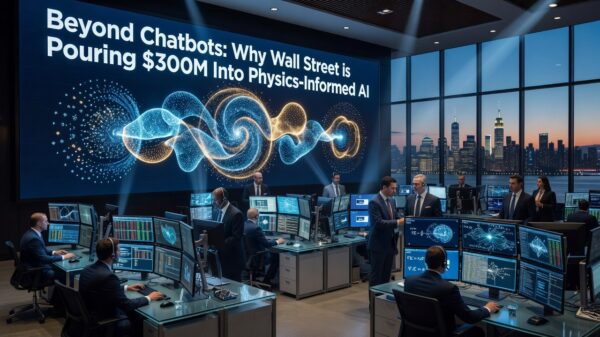
That era has a price tag attached to its ending: $300 million. That’s the Series C PhysicsX just closed at a $2.4 billion valuation, and the money isn’t just for a software company. It’s for redesigning the physical backbone that keeps heavy industry running — the grid, the turbines, the plants, the supply chains that produce steel, power, and silicon. When the money is that size and that patient — Temasek leading, with NVIDIA, Siemens, and Applied Materials backing the bench — it’s not a funding round anymore. It’s a verdict on what the next decade of industrial design will look like.
Why Heavy Industry Got Left Behind
Here’s the uncomfortable truth about industrial design: the tools that built the modern world are decades old and barely faster than when they were invented.
A computational fluid dynamics solver for a turbine blade or a wind farm still works the same way it did in the 1990s — chop the geometry into millions of cells, solve coupled equations iteratively, wait. A single run can eat a day. A design cycle that explores a dozen variants burns a month. So heavy industry made peace with a grim compromise: test fewer designs, keep margins wide, and never find out what the best option actually was. Jacomo Corbo, the McKinsey QuantumBlack alum who runs PhysicsX, has said the binding constraint on hardware innovation for decades wasn’t imagination. It was simulation latency.
PhysicsX attacks exactly that constraint. Its Large Physics Models learn from the outputs of classical solvers — millions of historical simulation results that were sitting on engineering servers, doing nothing — and then predict physical behavior in seconds. The company’s own benchmarks claim 10x to 100x speedups. Engineers don’t test a dozen variants anymore. They test thousands. And when the domain is a turbine, a grid component, or a semiconductor die, the difference between twelve designs and three thousand is the difference between incremental and transformative.
The Grid-Scale Math
Now multiply that by the size of the problem heavy industry is actually facing, and the $300 million starts to look small.
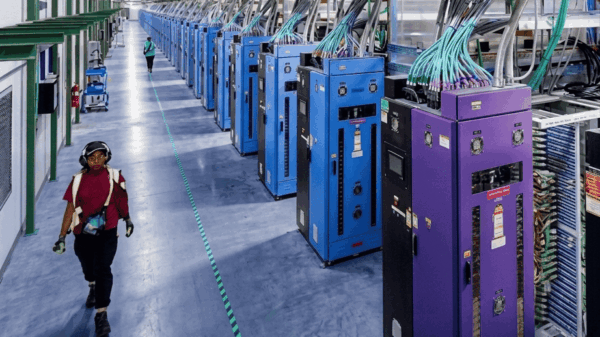
The electricity grid is being rebuilt while it’s still running. Data centers are pulling gigawatt-scale loads that regional grids were never designed for — the same power crunch we’ve watched reshape hyperscaler strategy, where the real ceiling isn’t chips anymore, it’s megawatts. Renewables need to plug into a system built for coal baseload. Steel and cement — two of the hardest sectors to decarbonize — need to redesign processes that haven’t changed in a century. Every one of those redesigns runs through simulation, and every simulation has to be run thousands of times before a single physical asset is built.
That’s the market PhysicsX is selling into, and it’s why the cap table reads like a strategic alliance rather than a venture deal. Siemens collaborates with the company specifically on data center power infrastructure applications — bringing physics AI to the very systems cooling and powering the AI boom. Applied Materials, an investor and a customer, points the models at semiconductor manufacturing, where heat and stress at the nanometer scale decide whether a chip yields or fails. NVIDIA supplies the GPU muscle through its PhysicsNeMo framework and has committed up to $100 million of its own. Even the hosting strategy signals intent: T-Systems runs PhysicsX models on its European Industrial AI Cloud, giving European industry a sovereign path to the technology.
The Design-Loop Advantage
Here’s the detail that explains why this is a catalyst and not just a check. Physics AI doesn’t just make one simulation faster — it changes the loop.
In the old world, you simulate, build, test, fail, and start over. Months per iteration, prototypes you can count on one hand. In the new world, the model predicts, the engineer adjusts, and the cycle runs in minutes inside the software before anything physical exists. You explore the failure space in simulation, where failure is free, instead of in the field, where it costs a plant. That’s why PhysicsX customers reportedly quadrupled their iteration counts while meeting deadlines — and why the company more than doubled its revenue, tripled its bookings, and grew past 300 people in a single year. The $300 million funds more of that: bigger pre-trained models, offices in the US and Singapore, and the hiring pipeline to serve industries that buy in decades, not quarters.
None of this is the futuristic stuff. This is the already-working version. And it’s the same physical-AI wave that’s pulling Hyundai deeper into robotics — the recognition that the next big AI wins won’t live inside chat windows but inside the machines that actually move, build, and power the physical world.
The Catch in the Concrete
Now the candid part, because redesigning the grid comes with a hard reality: heavy industry does not move at startup speed.
Certification is the wall. A turbine blade in a power plant doesn’t get to run because a neural network liked it. Regulators want audit trails, verification against physical tests, and proof that the model doesn’t quietly fail on the extreme conditions it’s never seen. That’s why PhysicsX keeps classical solvers in the loop and ships uncertainty quantification — the model literally tells the engineer when it’s guessing. It’s the right engineering answer. It’s also why the adoption curve in heavy industry will be measured in years, not months, and why the revenue growth will lag the valuation growth.
There’s also the data bargain, which deserves more scrutiny than it gets. PhysicsX models are trained exclusively on each customer’s own data — which is why they’re so accurate, and why the moat is so deep. But it means industrial giants must hand over their most sensitive engineering IP to a third party to get the speed. In an era of supply-chain paranoia, that’s a real decision, not a paperwork one. The firms that will survive the industrial AI transition are the ones that figure out how to share data without surrendering it.
What the Catalyst Actually Buys
Strip away the valuation drama and the $300 million buys one thing: time. Time to train larger models, time to earn certifications, time to build the trust that heavy industry requires before it hands over the keys to a power plant’s design cycle.
The grid that powers the modern world was designed in an era of slow math and safe choices. It’s being asked now to do something it was never built for — carry a decarbonized, AI-driven, energy-hungry economy. Redesigning it the old way would take generations. Redesigning it with physics AI might take a decade.
PhysicsX doesn’t build the transformers or pour the steel. It builds the speed at which all of that gets designed. And in an industry where the bottleneck was never ambition, only latency, speed is the entire game. That’s what the $300 million is really for — not a product, but a clock. The old one measured in weeks is finally being retired.
Source: PhysicsX — $300M Series C announcement

Independent technology writer focused on artificial intelligence, emerging technologies, and digital innovation. Covers AI applications in sports, productivity, and online business.