


































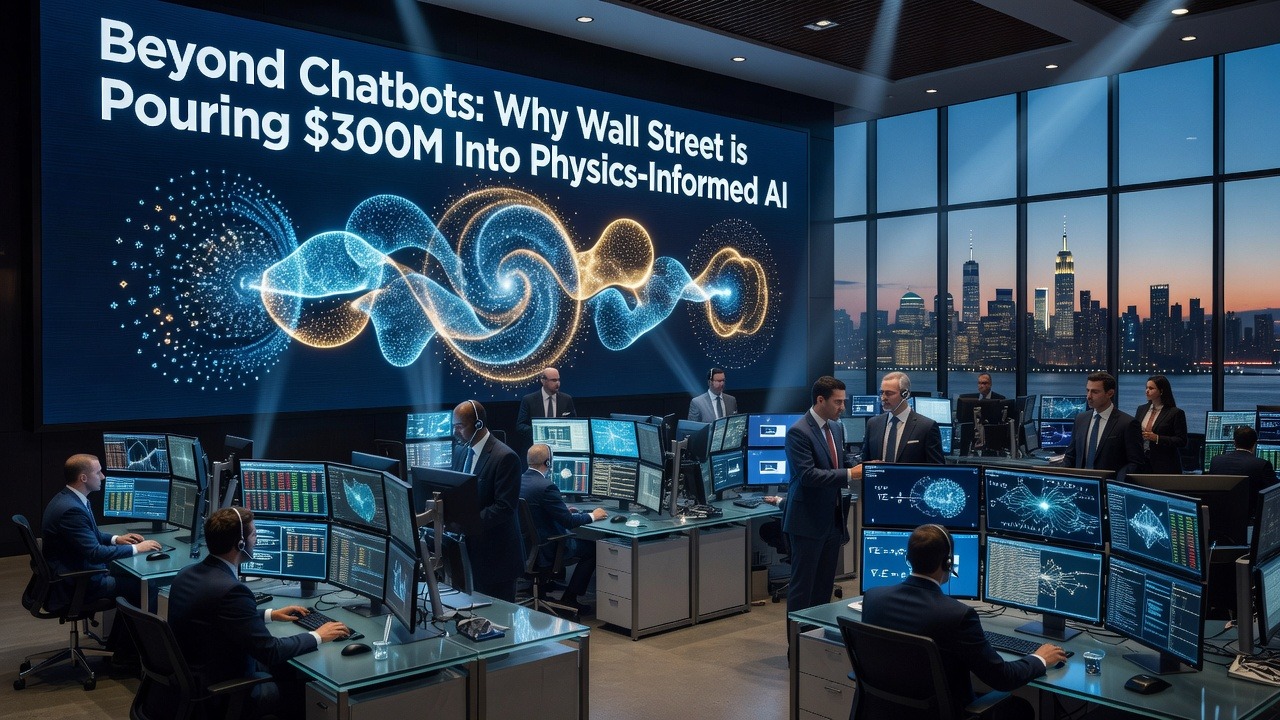
The last time Temasek led a $300 million round in an AI company, you’d have been forgiven for assuming the product wrote emails. It doesn’t. It simulates airflow over a turbine blade, stress in a jet engine, and heat in a semiconductor — and it just raised exactly that amount at a $2.4 billion valuation.
PhysicsX is the loudest signal yet that the money in AI is moving past the chatbots. Singapore’s sovereign wealth fund led the Series C, with NVIDIA, Siemens, Applied Materials, Atomico, and General Catalyst crowding in. Total funding now tops half a billion dollars, and the valuation has more than doubled in twelve months. For a company that emerged from stealth barely three years ago, that’s not a funding round. That’s a declaration.
Here’s the question nobody’s asking plainly enough: why is Wall Street — and, more tellingly, the world’s most selective institutional money — betting this hard on models that predict physics instead of language?
The Chatbot Ceiling
Start with what the past four years taught investors about LLMs. They trained models on everything, put them in front of billions of people, and discovered the same thing over and over: the value of a language model is enormous, but the revenue attached to it is thin. Subscriptions cap out. Ads cap out. The infrastructure bill doesn’t cap out — it just keeps inflating, which is why the hyperscalers are locked in a capex war they can’t exit. Conversation is a solved interface. Monetizing conversation is not.
Physics-informed AI goes the other direction. Instead of predicting the next word, these models predict the next state of a physical system — how a wing deforms, how heat moves through a chip, how a turbine behaves at the edge of its limits. And here’s the part investors actually care about: companies pay differently for physics than they pay for prose.
A chatbot saves you a junior writer. A physics model that compresses a two-week simulation into seconds changes whether a product ships this quarter or next — whether a wind turbine is 2% more efficient, whether an aircraft burns less fuel, whether a medical device passes certification. That’s not a productivity feature. That’s the physical economy’s bottom line, which is where most of the world’s actual value has always been produced. The pitch writes itself, and it writes it in dollars.
Why This Particular Bet
PhysicsX isn’t the only physics-AI company out there — Neural Concept and Rescale raised big rounds of their own last year — but the composition of this one is what makes it different. Read the cap table like a map and you see exactly what each player is buying.
Temasek is buying sovereign relevance: physics AI is one of the few technologies where Europe, the UK, and Singapore can plausibly lead, rather than follow the US-China AI duopoly. NVIDIA is buying a new anchor tenant for its GPUs — every trained physics model and every inference run is more accelerator demand, layered on top of the same GB200 infrastructure that’s reshaping the whole compute market. It has already committed up to $100 million through its venture arm. Siemens is buying an insurance policy: it embeds PhysicsX’s models inside its own Simcenter software rather than competing with them, which is how an incumbent survives a technology it can’t build fast enough itself.
The deeper thesis is about data. The most valuable thing PhysicsX owns isn’t its code — it’s the fact that its models are trained exclusively on each customer’s own simulation data. Every engagement deepens the moat, and every trained model becomes more accurate for that specific customer than any general-purpose competitor could hope to be. That’s the business model investors spent 2024 and 2025 searching for: AI with a switching cost.
The Hardware-AI Wave
This is bigger than one company. PhysicsX sits at the center of a pattern — call it physical intelligence — that’s pulling in hyundai’s robotics bet, the “physical AI” startups raising $230 million rounds, and a growing pile of manufacturing software. The throughline is that the LLM playbook — train at scale, sell the resulting capability — is being reapplied to anything that touches the real world. Models that understand fluids, forces, and materials instead of just syntax.
The market math explains the enthusiasm. The physics-AI slice of the simulation market is projected to grow from roughly $236 million today to over $680 million by 2035, inside a simulation software industry ballooning from $26.5 billion to $70 billion. Those are real numbers, but they’re also the slow version of the story. The aggressive version is what happens when physics models get good enough that classical solvers become the exception rather than the default — the same displacement curve that killed the slide rule.
The Fine Print the Term Sheets Won’t Show You
Now the part worth keeping a clear head about.
For all the enthusiasm, the economics of physics AI carry a built-in ceiling. These models live inside safety-critical, slowly-moving industries. Aerospace certification cycles take years. Regulators don’t accept “the neural network said so” as validation — which is why PhysicsX ships uncertainty quantification and keeps classical solvers in the loop for final sign-off. The AI accelerates exploration, not approval. That’s a longer sales cycle, and longer cycles are where startup momentum goes to die.
There’s also the same concentration risk that haunts every deep-tech bet. The models depend on customer data, which means the moat is only as deep as the willingness of conservative industrial giants to hand over their most sensitive engineering IP. If that pipeline stalls, so does the training flywheel. And if an incumbent decides to build instead of partner — the Siemens relationship is a deal, not a law of physics — the valuation math gets rewritten in a quarter.
Still, the direction is unmistakable. The same investors who spent three years chasing chatbots are now bidding for the right to fund the machines that build physical things. PhysicsX is the proof of concept, and OpenAI’s own march toward public markets suggests the pattern isn’t slowing down — the definition of “AI company” is just expanding past what fits in a chat window.
The chatbots got the headlines and the users. The physics models are getting the checks. Wall Street has a habit of paying for the thing it can’t see yet, and right now, that thing is a turbine blade that simulates itself in seconds.
Source: PhysicsX — $300M Series C announcement

Independent technology writer focused on artificial intelligence, emerging technologies, and digital innovation. Covers AI applications in sports, productivity, and online business.