


























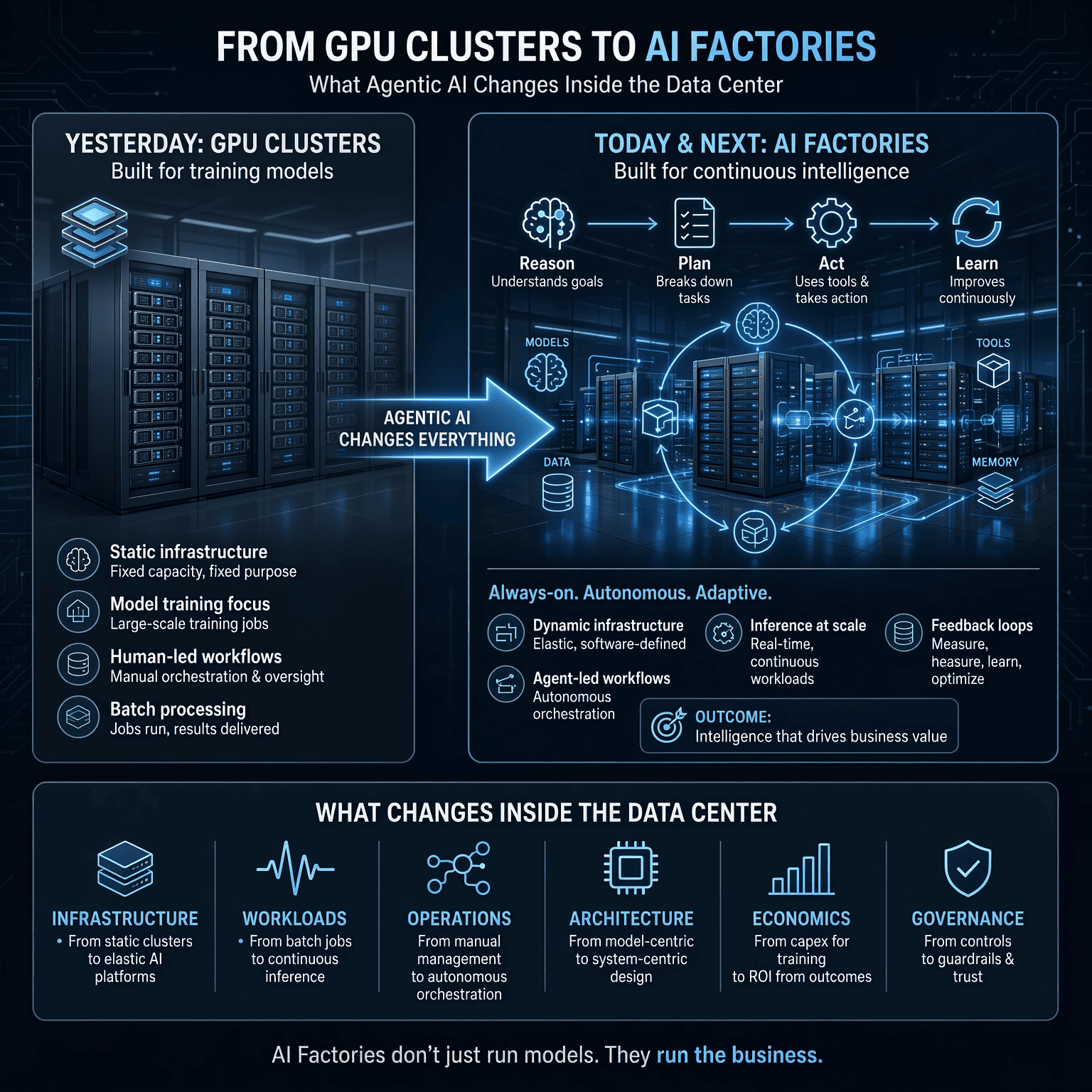

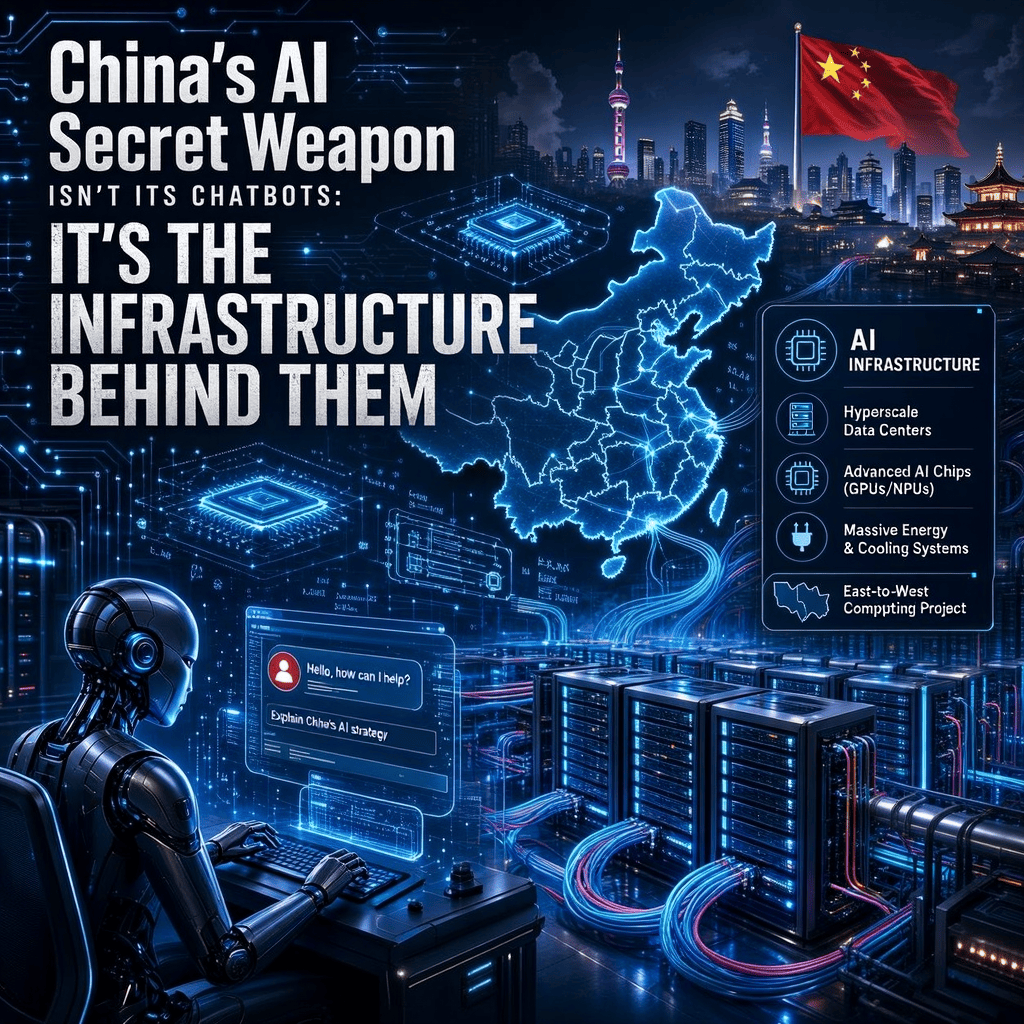
The conversation about China’s AI capabilities gets stuck on models. DeepSeek. Qwen. The latest benchmark scores. Whether Chinese chatbots can match GPT-4o on reasoning tasks. This fixation misses what actually matters. The chatbots are the visible surface. Beneath them lies something far more consequential a physical and institutional infrastructure buildout that is reshaping the balance of power in artificial intelligence on a scale that has no precedent in technological history.
As one senior energy analyst put it: “The US has the chips and is short on power, while China has the power and is short on chips. Each is sprinting to fix its own bottleneck.” But that framing, while neat, understates what China is actually building. It is not simply filling a gap. It is constructing a vertically integrated AI industrial base compute, energy, cooling, connectivity, chips, software, and policy in a way that no other country has attempted.
The Numbers Nobody Talks About
Start with the raw scale. China’s intelligent computing capacity reached 2,185 EFLOPS by the end of June 2026, a 177% increase year-over-year. That figure comes from the Ministry of Industry and Information Technology and represents the total installed AI-specific compute across the country. To put it in context, China’s government had originally set a target of 300 EFLOPS of total computing power with 105 EFLOPS dedicated to AI by the end of 2025. It blew past that target by a factor of roughly seven on the AI side alone.
The physical infrastructure behind those numbers is staggering. China’s data center capacity stood at approximately 32 GW at the end of 2025. It is projected to reach 40 GW by the end of 2026 and could exceed 60 GW by 2030, according to Rystad Energy analysis. That trajectory means data center power consumption will roughly double, reaching 289 terawatt-hours by 2030 more than the entire country of Germany uses today.
By one demand-side analysis from ChinaTalk, China’s total AI chip stock the number of H100-equivalent processors in the country could be anywhere from 1.9 million to 5.6 million units, with a central estimate around 2.8 million. The uncertainty is wide because Chinese firms have strong incentives to understate their compute, and because much of the hardware is still flowing through complex procurement channels. What is clear is the trajectory: China is acquiring AI chips at an extraordinary pace, and the infrastructure to house, power, cool, and connect them is expanding in lockstep.
The East-West Computing Project: Strategy at a Continental Scale
The centerpiece of China’s infrastructure strategy is the “East Data, West Computing” initiative, launched in 2022. On its surface, it sounds like a simple geographic redistribution move data processing from the expensive, crowded eastern coast to the cheaper, emptier western interior. The reality is far more sophisticated.
The project designates eight national computing hubs and ten data center clusters across the country. Western hubs in Guizhou, Inner Mongolia, Gansu, and Ningxia are built to handle non-real-time and latency-tolerant workloads model training, batch processing, disaster recovery, backup storage. Eastern hubs in Beijing-Tianjin-Hebei, the Yangtze River Delta, and the Greater Bay Area handle real-time, latency-sensitive tasks. The idea is not just to redistribute load but to create a national computing network where workloads flow to the optimal location based on cost, energy availability, and latency requirements.
The numbers tell the story of implementation. Direct government investment reached 43.5 billion yuan (6.1billion) by mid−2024,catalyzing over 200 billion yuan (27 billion) in total investment from state-owned enterprises, private capital, and local governments. The eight national computing hubs now account for 70% of national computing capacity. By 2030, the government expects the project to draw roughly 4 trillion yuan ($560 billion) in new direct investment.
The geographic logic is compelling. Western regions offer 9.5 times the land area per capita compared to the east and four times the capacity to integrate renewable energy into the grid. Average temperatures in western hub areas run low enough for natural cooling eight to ten months per year. Land costs are a fraction of eastern megacity prices. Electricity is cheaper and increasingly green. The result is a structural cost advantage that compounds over time.
This is not just a data center project. It is an economic development strategy, a climate policy, and a national security initiative rolled into one. The government has tied computing infrastructure to its broader “Six Networks” initiative alongside water networks, power grids, communications, underground pipelines, and logistics treating compute as a utility on par with electricity and water.
The Energy Equation: Cheap, Abundant, and Increasingly Green
Energy is the hidden edge that most Western analysts underestimate.
China already generates more than twice as much electricity as the United States 10,707 TWh versus 4,670 TWh in 2025. More importantly, it is expanding generation capacity at a pace that dwarfs every other country. BloombergNEF estimates China will add more than 3.4 terawatts of generation capacity by 2030, nearly six times the US total. In 2025 alone, China added over 430 GW of wind and solar capacity more than half of all renewable capacity added globally that year.
Electricity costs in China’s three largest data center markets Guangzhou, Shanghai, and Beijing average 0.07 to 0.09 per kWh. In some western regions, prices are lower still. State-owned utilities absorb cost spikes. The National Development and Reform Commission sets benchmark prices and permits fluctuations within narrow bands. For an industry where electricity accounts for 60% to 70% of operating costs, this matters enormously.
The integration of renewable energy with computing infrastructure is accelerating. All new data center projects within the eight national computing hubs must source at least 80% of their power from renewable energy under the 2025 green data center action plan. In May 2026, China’s first large-scale green power direct-supply project began operation in Zhongwei, Ningxia a 500 MW solar farm connected by dedicated transmission lines directly to a cloud data center cluster. When a companion 1.5 GW wind farm comes online, the combined facility will generate 4.3 TWh annually, more than enough to meet the cluster’s 2.29 TWh annual demand.
Undersea data centers powered by offshore wind have been deployed off the coast of Shanghai. A data center in Ulanqab, Inner Mongolia, runs on 200 MW of wind, 100 MW of solar, and 45 MW/180 MWh of battery storage. In Qinghai, a pilot facility operates entirely on a solar microgrid. The pattern is consistent: co-locate compute with clean energy, minimize transmission losses, and drive down both cost and carbon simultaneously.
Compare this to the United States, where AI power demand is colliding with a grid that has been essentially flat for decades. The sudden surge from data centers has created permitting bottlenecks, interconnection queue backlogs, and community opposition. At least 36 data center projects were blocked or stalled in the US between May 2024 and June 2025. Wood Mackenzie reported a 50% quarter-on-quarter drop in new US data center projects at the end of 2025 due to grid constraints. China faces no comparable friction.
The Huawei Ecosystem: Building a Complete Chip Stack
The chip story is more nuanced than the headlines suggest. Yes, US export controls have denied Chinese firms access to Nvidia’s most advanced processors. Yes, SMIC cannot match TSMC’s leading-edge nodes. But the assumption that chip constraints would cripple China’s AI development has proven wrong and the reason is Huawei.
Huawei is building something that does not exist anywhere else in the world: a vertically integrated AI compute stack that spans chips, interconnects, software frameworks, and system architecture. Its Ascend series of AI processors designed in-house using the proprietary Da Vinci architecture has evolved from the original 910 in 2019 through the 910C dual-chiplet design to a detailed roadmap extending through 2028.
The roadmap is aggressive. The Ascend 950PR launched in early 2026, delivering 1 PFLOPS in FP8. The 950DT follows in late 2026 with higher memory bandwidth for training workloads. The Ascend 960 arrives in late 2027, targeting 2 PFLOPS in FP8 and 4 PFLOPS in FP4. The Ascend 970, expected in late 2028, aims for 4 PFLOPS in FP8 and 8 PFLOPS in FP4 designed to support models scaling to 10 trillion parameters and beyond. Each generation doubles compute, and Huawei has committed to an annual release cadence.
Bloomberg reported in September 2025 that Huawei planned to produce approximately 600,000 of its flagship 910C Ascend chips in 2026, roughly double the 2025 level. Total Ascend die production was expected to reach 1.6 million in 2026. After the release of DeepSeek V4 in April 2026 the first Chinese model optimized specifically for Huawei silicon demand for the newer Ascend 950 surged, with ByteDance, Tencent, and Alibaba all rushing to secure orders.
The per-chip performance gap with Nvidia remains real. The Ascend 910C delivers roughly 60% of H100-class inference performance, and training efficiency is lower. But Huawei’s strategy is not to compete chip-for-chip. It is to compete system-for-system. The CloudMatrix 384 system combines 384 Ascend 910C accelerators into a single fabric delivering around 300 PFLOPS of aggregate throughput. The Atlas 950 SuperPod scales to 8,192 NPUs. The Atlas 960 SuperCluster aims for over one million NPUs operating as a single logical system. Huawei compensates for weaker individual chips with massive parallelism, proprietary interconnects, and aggressive power budgets.
The supply chain around Huawei is thickening rapidly. Huawei’s investment arm Hubble has taken stakes in more than 60 semiconductor companies covering everything from packaging materials and photoresists to gas delivery systems and electronic design automation. Chinese data centers are now required to use at least 80% domestic technology, effectively squeezing out Nvidia and AMD. National Big Fund Phase III has committed over $47 billion to semiconductor development. The combined effect is a domestic chip ecosystem that is imperfect but functional and improving rapidly.
Huawei’s proprietary memory technologies HiBL 1.0 for cost-effective HBM-like performance and HiZQ 2.0 for higher bandwidth are designed to work around the lack of access to HBM4 from global suppliers. The UnifiedBus (UB) interconnect protocol claims 2.1 microsecond latency and TB/s-scale bandwidth for binding thousands of NPUs into a single system. None of these components match the best Western equivalents individually. Together, they form a system that can train and serve large AI models at scale within China’s borders.
The Software Multiplier: DeepSeek and the Efficiency Imperative
If infrastructure is the body, software is the nervous system and China has been forced into a distinctive approach.
DeepSeek is the most visible example, but the pattern is broader. Chinese AI labs, constrained by chip access, have invested heavily in algorithmic efficiency. DeepSeek V3 was trained on 2,048 Nvidia H800 GPUs chips with half the interconnect bandwidth of H100s, permitted for export to China at a reported cost of $5.6 million. That figure undercounts the true expense (it covers only the final successful training run, not the hundreds of experiments that preceded it), but the engineering achievement is real. The model’s Mixture-of-Experts architecture activates only 37 billion of its 671 billion parameters per token, dramatically reducing per-token compute.
The technical innovations stack up. Multi-head Latent Attention compresses KV caches to reduce memory consumption. FP8 mixed-precision training cuts computational costs while maintaining accuracy within 0.25% of higher-precision baselines. The DualPipe algorithm overlaps computation and communication phases, reducing pipeline inefficiency to near-zero communication overhead. A custom Multi-Plane Fat-Tree network topology supports over 10,000 GPUs in a two-layer network at significantly lower cost than traditional three-layer architectures.
DeepSeek V4, released in April 2026, marked a turning point: the first major Chinese model optimized for domestic inference on Huawei Ascend chips. This is not just a model it is proof of concept for an entire alternative AI stack that does not depend on American hardware. DeepSeek’s DSpark speculative decoding framework increased inference speeds by up to 85%, reducing the hardware required to serve large models.
The broader Chinese AI ecosystem has embraced this efficiency-first philosophy. Open-source model development from Alibaba’s Qwen series to Tencent’s Hunyuan to Kimi K3 from Moonshot AI creates a shared foundation that individual companies build on. The result is a network effect: better software optimization makes domestic chips more usable, which increases demand, which funds more chip development, which drives more software optimization.
The Cooling Revolution: An Overlooked Bottleneck
One of the most underappreciated aspects of China’s infrastructure advantage is cooling technology.
AI chips are power-hungry. The next generation of Nvidia processors Vera Rubin, expected in 2026 will push individual chip power consumption past 1 kW, with rack power densities exceeding 200 kW. Air cooling physically cannot dissipate this heat. Liquid cooling is not optional; it is mandatory for the next generation of AI infrastructure.
China is ahead. Liquid cooling penetration in Chinese data centers jumped from about 14% in 2024 to around 33% in 2025, with some hyperscale facilities already exceeding 60% liquid-cooled racks. By 2027, industry forecasts suggest penetration will approach 60%. Beijing, Shenzhen, Guangzhou, Hangzhou, and Suzhou have written “default liquid cooling for new hyperscale facilities” into their regional computing plans.
The supply chain is scaling fast. Envicool, a Shenzhen-based precision cooling company, is building capacity to exceed 10 GW of rack capacity by 2027, with domestic and overseas factories in Zhengzhou, Shenzhen, Penang (Malaysia), and Rayong (Thailand). Its customers include Nvidia, Intel, Alibaba, and Tencent. Google has sent procurement teams to China to negotiate liquid cooling purchases, reflecting tight global supply. The fact that the world’s largest AI companies are buying cooling infrastructure from Chinese suppliers is a telling indicator of where the manufacturing advantage sits.
Chinese firms are also pioneering innovative approaches. Undersea data centers use ocean water for natural cooling, achieving PUE ratings as low as 1.15. Immersion cooling submerging entire servers in dielectric fluid is being deployed at scale in clusters across Inner Mongolia, Ningxia, and Gansu. Huawei’s Thermal Management Unit (TMU) represents a generational leap beyond passive cooling distribution, incorporating AI-driven load optimization, hot-swappable modular design, and predictive maintenance.
By 2030, China’s data center cooling market is expected to be worth over 300 billion yuan. The domestic cold plate market alone is growing at a 47.7% CAGR. China is not just consuming cooling technology it is defining the standards. Huawei, Alibaba, Tencent, and the China Academy of Information and Communications Technology are drafting domestic liquid cooling standards expected to be released mid-2026.
The Invisible Network: Fiber, Interconnects, and the Nervous System
Behind every AI cluster is a network and China is building networks at a scale and sophistication that gets less attention than it deserves.
China Telecom has developed the world’s first end-to-end high-performance optical interconnect system for AI computing data centers, enabling geographically distributed clusters to operate as a single lossless, resilient supercomputer. The system achieves 800 Gbps per wavelength between data centers with millisecond-level latency. Field trials have demonstrated distributed training of a 177 billion parameter model across 1,024 GPUs over 120 km with over 95% efficiency compared to centralized training. A subsequent pilot achieved the same across 500 km, reaching 97% to 99% of single-datacenter training performance.
In May 2026, CICT debuted the world’s highest-fiber-count optical cable: 13,824 cores in a single cable with an outer diameter of just 40 mm. A single cable can replace 48 conventional 288-core cables, saving over 90% of pipeline resources. This is not a laboratory curiosity it has been mass-produced.
Researchers at Pengcheng Laboratory in Shenzhen are developing a new type of optical fiber that packs four separate channels into a single hair-thin strand, designed to quadruple data capacity between key hubs. A 1,000 km deployment linking Shenzhen to Guizhou is planned to create a national corridor for high-bandwidth, low-latency compute dispatch.
China Telecom is building an “eight vertical, eight horizontal” backbone optical cable network and accelerating transmission links to 800G. It is exploring ultra-large-capacity optical circuit switching (OCS) networking all-optical routing that eliminates electro-optical conversions, reducing latency and power consumption while supporting clusters scaling to millions of GPUs. China Mobile has completed commercial deployment of its GSE (General Scheduler Ethernet) network for AI workloads, demonstrating 50%+ performance improvements over traditional RoCE networks.
The result is not just faster networking but a qualitatively different architecture. China is building a national computing fabric where workloads can be dispatched across regions in real time. In a test in May 2026, China Telecom successfully shifted computing tasks from Shanghai to a green computing center in Karamay, Xinjiang over 4,000 km away dropping the Shanghai facility’s local power load by 75% while seamlessly transferring tasks across heterogeneous hardware. More than 60% of the country’s AI compute is now visible to a new national monitoring and scheduling platform.
The Geopolitical Calculus: What This Means
The implications of China’s infrastructure buildout extend far beyond the AI industry.
First, export controls are producing unintended consequences. By denying Chinese firms access to the most advanced chips, Washington has forced a level of domestic innovation that would not have occurred otherwise. DeepSeek’s efficiency breakthroughs, Huawei’s aggressive chip roadmap, and the broader software-hardware co-design movement are all, in part, products of constraint. As Brookings researcher Kyle Chan noted: “Despite these restrictions, Chinese AI labs have managed to trail closely behind top American labs, likely through a combination of model efficiency improvements, chip smuggling, access to overseas compute resources, model distillation, and other factors.”
Second, China’s open-source strategy is creating a global gravitational pull. Chinese AI models DeepSeek, Qwen, and others are free, well-documented, and increasingly competitive on performance benchmarks. They are being adopted by developers, enterprises, and governments worldwide. Each adoption creates a dependency on the Chinese AI stack and generates data that feeds back into model improvement. The US-EU-India open-source ecosystem, by contrast, lacks comparable coordination and scale.
Third, the infrastructure advantage compounds over time. Data centers, once built, operate for decades. Energy infrastructure, once connected, locks in cost structures. Cooling systems, once deployed, define what hardware can be installed. The network topologies currently being built will shape which models can be trained and served for years. China is making infrastructure decisions today that will constrain or enable its AI capabilities through the next decade.
Fourth, the physical economy matters. China’s AI strategy is not primarily about building the most powerful chatbot. It is about deploying AI across the largest manufacturing base in the world factories, logistics, quality inspection, robotics, autonomous vehicles, smart cities. Each deployment generates proprietary operational data. That data feeds back into model improvement. The improved models enable more sophisticated deployment. This physical deployment loop, as the US-China Economic and Security Review Commission has documented, operates largely independently of frontier compute constraints and is building durable advantages that export controls cannot touch.
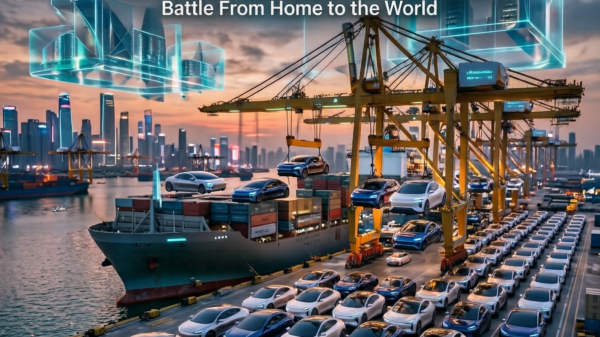
Fifth, there is a pattern here that transcends AI. China won the EV race not by building better cars, but by building the battery industry first controlling the supply chain, the manufacturing processes, and the cost structure before competitors understood what was happening. The AI infrastructure play follows the same logic. Build the foundation. Control the inputs. Let the products follow.
The Trade-Offs Are Real
None of this means China has won. The constraints are genuine and significant.
Per-chip performance lags behind. The Ascend 910C’s silicon footprint is roughly 60% larger than Nvidia’s H100, with lower performance per square millimeter and per watt. Huawei’s clusters consume more power and occupy more floor space to achieve comparable throughput. SMIC’s manufacturing yields trail TSMC. The software ecosystem Huawei’s CANN platform still lacks the maturity and developer adoption of CUDA.
Quality control issues exist. Some Chinese data centers, built rapidly by developers without deep experience, have faced construction quality problems. Heterogeneous chip clusters mixing different hardware systems make running AI workloads more challenging. Beijing’s own estimates put data center utilization at 20% to 30% in some regions a significant portion of capacity may be sitting idle.
The energy advantage, while real, faces implementation challenges. Most data centers are still in eastern megacities where power supply is constrained. China’s power grid suffers from provincial fragmentation that prevents seamless inter-regional electricity flow. The 80% renewable energy target for computing hubs remains aspirational; actual renewable integration rates in western hubs are 45% to 55%, well below the target.
And the US still leads at the frontier. American hyperscalers plan to spend over $630 billion on AI infrastructure in 2026 alone. The largest training clusters remain on American soil. US models maintain a clear lead in math, reasoning, code generation, and long-horizon agentic tasks. Capital availability with the US capturing 75% of global AI venture capital remains a structural advantage.
The Real Competition
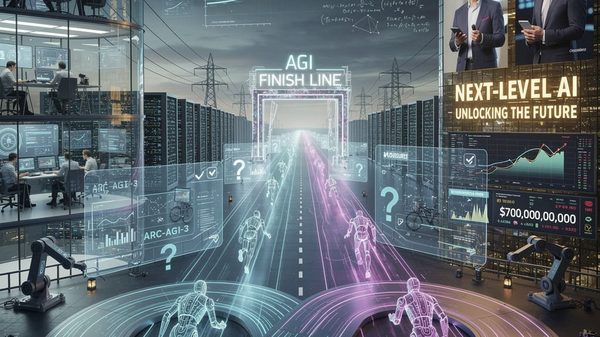
The AI race is not a single contest with a finish line. It is a multi-dimensional competition playing out across compute, models, energy, infrastructure, manufacturing, deployment, standards, and geopolitics simultaneously. The side that builds the most powerful model may not be the side that captures the most value from AI.
China is betting that infrastructure the physical, institutional, and systemic foundation on which AI runs is the durable advantage. Not the chatbot of the week. Not the latest benchmark. But the data centers, the power supply, the cooling systems, the fiber optic networks, the domestic chips, the open-source models, and the deployment loops across the world’s largest industrial base.
Whether that bet pays off depends on execution, on whether domestic chips can close the performance gap, on whether energy infrastructure keeps pace with demand, and on whether the open-source ecosystem continues to attract global adoption. But the bet itself made with the full weight of state planning, hundreds of billions of dollars, and an industrial policy that treats compute as a strategic resource is something the world has never seen before.
The chatbots are not the story. The infrastructure is.
This article synthesizes data from government sources (NDRC, MIIT), industry research (Rystad Energy, TrendForce, BloombergNEF, IEA), academic analysis (CSIS, Carnegie, Brookings), and investigative reporting (Reuters, Bloomberg, AP News, SCMP, Caixin Global). All figures cited reflect the most recent publicly available data as of August 2026.

Independent technology writer focused on artificial intelligence, emerging technologies, and digital innovation. Covers AI applications in sports, productivity, and online business.