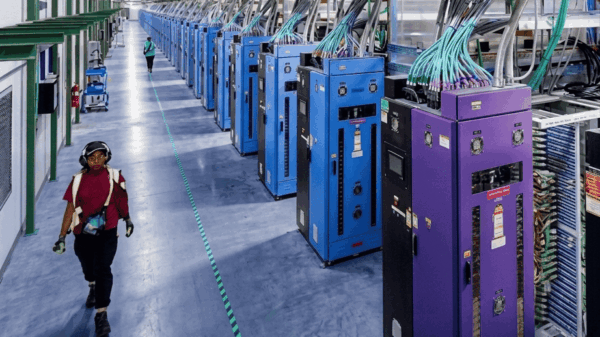








































Amazon’s $220 billion capex plan isn’t really about cloud computing anymore. The money is being spent on the two things that actually decide whether AI scales: memory chips and megawatts.
On Thursday’s Q2 call, CEO Andy Jassy confirmed the upgraded figure roughly $220 billion for 2026, up from $200 billion and conceded that even at that pace, AI capacity stays constrained through 2027, with contracted demand locked in through 2028. The telling detail: the extra $20 billion is driven mostly by memory costs, not construction. Amazon is now spending so fast that free cash flow swung to a $7.6 billion outflow, and the bill keeps growing.
Why It Matters
This is where the capex actually lands and it’s not in AWS’s server racks. Amazon’s buildout is remaking two industries at once: the semiconductor supply chain and the American power grid.
On the chip side, the company is throwing its weight behind in-house silicon. Trainium and Graviton chips already clear $10 billion in annual run-rate revenue, and AWS is reportedly in talks to sell Trainium outside its own cloud. That’s Amazon betting that the most interesting chip of the AI era isn’t the most powerful one — it’s the one you don’t have to beg Nvidia for.
On the power side, the numbers get genuinely huge. Amazon plans to double its power capacity by the end of 2027 versus 2025. It has already spent roughly $18 billion on a 17-year deal with Talen Energy for 1.9 GW from the Susquehanna nuclear plant, backed X-energy with $700 million for small modular reactors in Washington state, and signed deals with Dominion Energy in Virginia. That’s not a cloud strategy. That’s an energy company that happens to sell compute — and it’s the same arms-race logic Big Tech has applied to the broader $700 billion AI race.
Technical Breakdown
Follow the money to the actual bottlenecks and the story changes shape.
Memory is the real choke point, not GPUs. High-bandwidth memory (HBM) — the tightly-packed stacks co-packaged onto every AI accelerator consumes roughly 22% of the world’s DRAM wafer capacity while producing only about 10% of bit shipments. Every GPU Amazon racks needs a memory allocation that’s already spoken for years in advance. Conventional DRAM prices jumped 58-63% quarter-over-quarter. That’s why Amazon, Microsoft, Google, and Meta forward-ordered Nvidia systems through 2027, and why Amazon’s capex guidance keeps climbing even when construction plans don’t change.
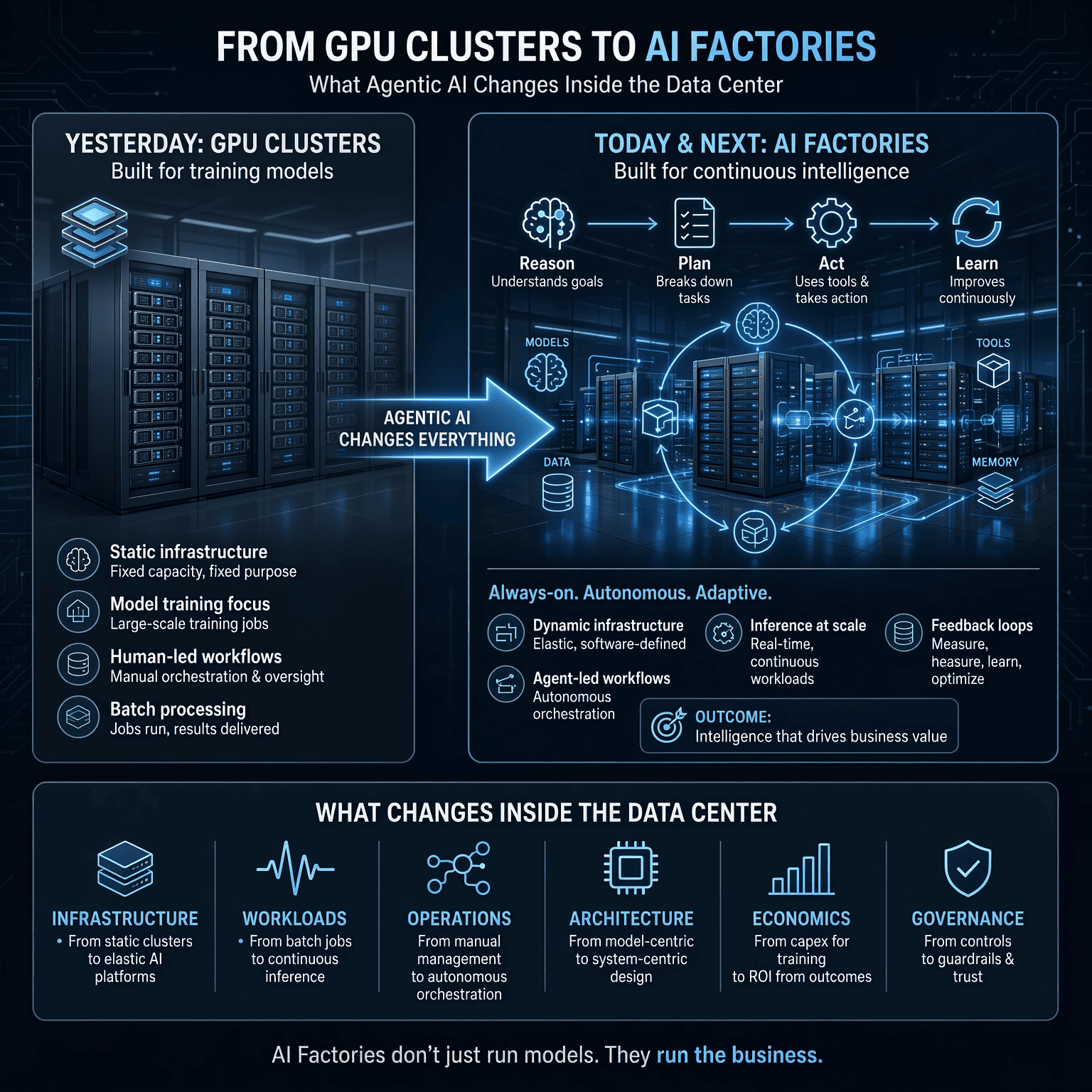
The company’s hedge is architectural: budget for Nvidia plus Trainium plus AMD, and design clusters that run on at least two accelerator families. The hidden infrastructure behind AI agents shows exactly why that pluralism matters — a GB200 rack is as much a memory and power problem as a compute one.
Power is the second wall. Global data centers burned roughly 415 TWh in 2024 — about what Italy consumes in a year. The IEA projects that number roughly doubles to 945 TWh by 2030. Amazon’s answer is buying nuclear capacity at a scale the industry has never seen: hyperscalers have committed 9.8 GW of nuclear across 13 announced deals, and Amazon’s Susquehanna PPA is one of the few already flowing electrons. The company is also leaning into small modular reactors — the X-energy deal with Energy Northwest covers up to 960 MW across as many as 12 Xe-100 units in Washington — to feed facilities that can’t wait for the grid to catch up.
The Catch / Friction
Here’s where Amazon’s remaking of the landscape gets messy.
The FERC rejection this week of Amazon’s Talen arrangement which would have boosted the Susquehanna campus from 300 MW to 480 MW of shared power is a warning shot. Regulators said the deal could raise public power bills and threaten grid reliability. That’s the same complaint echoing through Ohio, Oregon, and Georgia, where communities are pushing back on data centers and AEP Ohio has frozen new interconnections. Every gigawatt Amazon locks up behind the meter is a gigawatt someone else can’t reach.
The memory crunch has an even sharper edge. Every wafer redirected to HBM is a wafer stolen from standard DDR5, phones, and PCs. Consumers are already paying the price through higher hardware costs and the surging prices of Nvidia’s B300 accelerators are squeezing everyone who isn’t a hyperscaler with a long-term supply agreement. Small labs, enterprise IT, and sovereign AI programs are finding that the market has effectively closed to them.
And the nuclear pivot carries its own risk profile. First-of-a-kind SMR costs run $80-150/MWh, well above the $60-80/MWh target that makes the economics work. Timelines slip by 1-3 years as a matter of course. Amazon’s $220 billion is buying commitments, not kilowatt-hours only 1.92 GW of the 9.8 GW hyperscalers have committed to is actually operational. Ask IBM how its own billion-dollar infrastructure gamble is looking when the payoff is two to five years out.
Looking Ahead
For the next two years, watch the grid, not the cloud. If Amazon’s nuclear deals survive FERC scrutiny and its SMRs come online on schedule, AWS turns into the world’s most vertically integrated AI machine silicon, power, and compute under one roof. If power interconnection fights and memory allocation delays keep pushing delivery dates, the $220 billion becomes a stockpile of underutilized capacity with a $7.6 billion annual bleed.
Either way, one thing is settled: the AI arms race has stopped being about software and started being about who controls the hardware supply chain and the electrical grid that feeds it. Amazon is betting it can own both. The rest of the industry is betting against the timeline.
source :

Independent technology writer focused on artificial intelligence, emerging technologies, and digital innovation. Covers AI applications in sports, productivity, and online business.