













What you’ll get: the straight answer not the scary headline, not the comforting denial. This guide walks through the actual mechanisms by which AI could amplify or trigger a crisis, the historical record of machine-driven market failures, and the guardrails that decide which future we get.
Table of Contents
- The Question Everyone Asks, the Answer Nobody Gives
- What “Chaos” Actually Means Here
- The Historical Record: Machines, Humans, and Past Crises
- Four Pathways to an AI-Accelerated Crisis
- The Case for AI as a Crisis Preventer
- The Honest Verdict
- A Scenario: What It Could Look Like (Clearly Hypothetical)
- The Guardrails That Actually Matter
- What to Do (By Stakeholder)
- FAQ
- Conclusion
The Question Everyone Asks, the Answer Nobody Gives
“Will AI cause the next financial crisis?” is one of those questions that produces two kinds of content: fear pieces predicting a robot-caused Great Depression, and reassurance pieces insisting machines are just tools. Both miss the point.
The honest answer is more interesting than either: AI will almost certainly be a decisive amplifier and transmitter of the next crisis — but it is very unlikely to be its root cause. Financial crises begin with human behavior: leverage, mispriced risk, fraud, herding, complacency. What machines change is what happens after the trigger — the speed, scale, and correlation of the collapse. And in one specific case, the AI boom itself carries the classic anatomy of a bubble that could burst on its own.
To understand this, you have to look at the mechanisms, not the metaphors. So let’s look at the mechanisms.
What “Chaos” Actually Means Here
“Chaos algorithms” is a seductive phrase, so it’s worth being precise. Chaos theory — the mathematics that grew out of Lorenz’s weather models — describes deterministic systems that are exquisitely sensitive to initial conditions. Tiny differences in starting point grow exponentially, so even a system with no randomness becomes effectively unpredictable. The famous image is the butterfly effect.
Markets were studied as potentially chaotic systems for decades before AI. The finding, in simplified form: financial markets behave like weakly nonlinear, high-dimensional systems. Small events can cascade; prediction horizons are short; and feedback loops matter more than any single actor.
Here is the key point most commentary misses: AI does not make markets chaotic. They were already chaotic. What AI changes is the speed and coupling of the feedback loops that run through that chaos. When a thousand algorithms respond to the same signal within milliseconds, the system’s behavior is still deterministic — but the cascade happens faster than any human can intervene. The chaos was always there. The reaction time was not.
That distinction — chaos as a pre-existing condition, AI as an amplifier of its speed — is the single most important idea in this entire article.
The Historical Record: Machines, Humans, and Past Crises
Before predicting what AI will do, check what machines have already done. The record is instructive, and it runs in both directions.
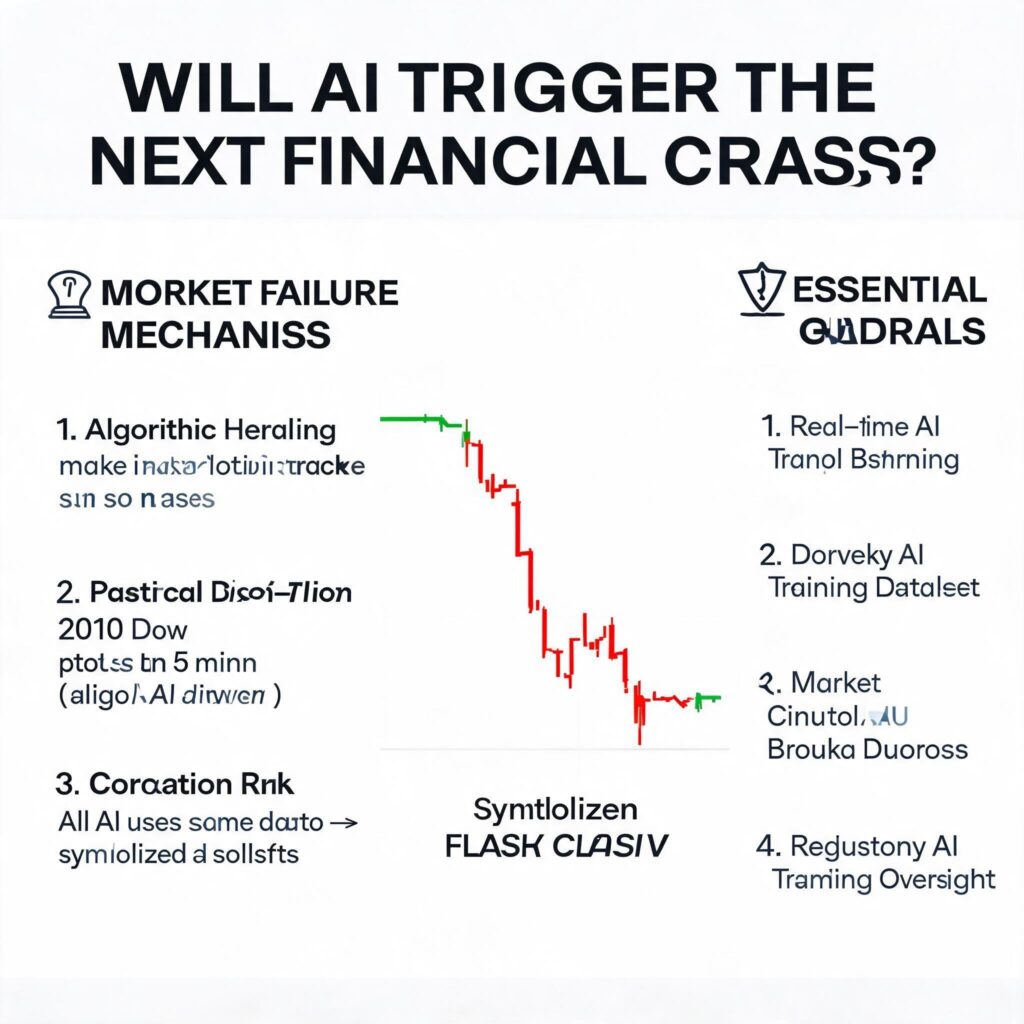
1987 — Black Monday. On October 19, 1987, the Dow lost over 22% in a single day. The trigger is still debated, but “portfolio insurance” — a pre-AI programmatic strategy that sold futures as prices fell — was widely identified as the amplifying mechanism. Machines didn’t start the fire; they turned a correction into a cascade. The mechanism: a feedback loop where falling prices triggered automated selling, which pushed prices lower.
2008 — the human crisis. The subprime crisis is the counter-example that matters. It was not caused by machines. It was caused by leverage, opaque derivatives, broken credit ratings, and billions of human decisions built on an assumption that housing prices would not fall nationally. Anyone who blames “robots” for 2008 is telling themselves a comfortable story. That crisis was us.
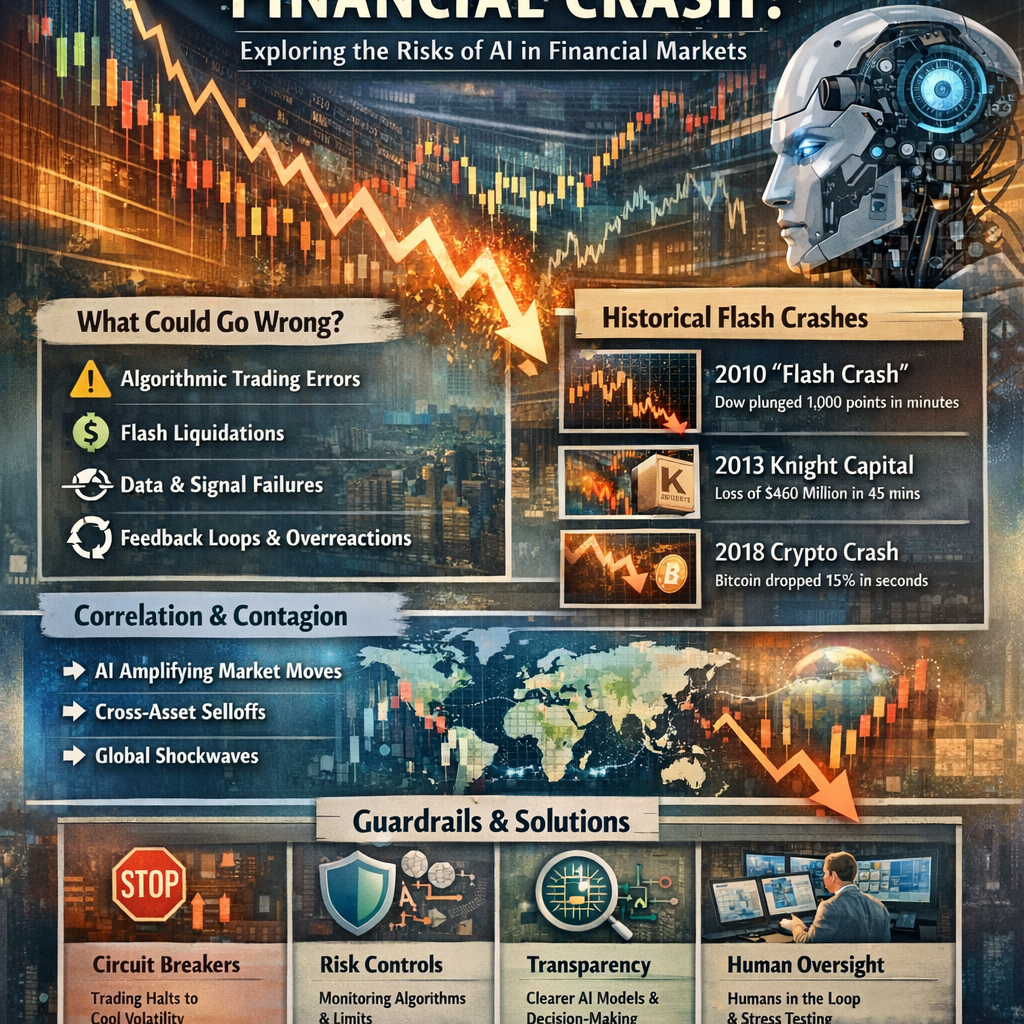
2010 — the Flash Crash. On May 6, 2010, the Dow dropped almost 1,000 points in a matter of minutes, erasing roughly $1 trillion in paper value, before recovering most of it within the session. Regulators later concluded that a single automated execution algorithm, interacting with a market where high-frequency traders had withdrawn liquidity, triggered the cascade. This is the closest documented example of what an AI-accelerated crisis looks like: not a rational repricing, but a liquidity vacuum — machines on one side stopped trading, machines on the other side chased the move.
2012 — Knight Capital. A flawed software deployment caused a trading algorithm to buy and sell errantly, producing losses of around $440 million in under an hour — effectively bankrupting the firm. The failure wasn’t a model being wrong; it was an automated system running at scale with a bug, and no effective kill switch.
2018 — “Volmageddon.” In February 2018, a spike in volatility triggered the collapse of short-volatility products in a single session, as leveraged, correlated strategies all de-risked simultaneously. No algorithm was “evil.” A crowded trade simply unwound all at once.
The pattern across these episodes is consistent: the root cause is human — a flawed strategy, a crowded trade, a bug — and the amplifier is automation. Every machine-driven market episode in history followed that shape.
| Episode | Root Cause (Human) | Amplifier (Machine) | Lesson |
|---|---|---|---|
| 1987 Black Monday | Portfolio insurance strategy | Programmatic feedback selling | Automated de-risking cascades |
| 2008 subprime | Leverage + mispriced risk | Not machine-driven | Don’t blame machines for human greed |
| 2010 Flash Crash | A single large automated order | Liquidity withdrawal + speed | Liquidity can vanish in seconds |
| 2012 Knight Capital | A software bug | Execution at full scale | Kill switches are essential |
| 2018 Volmageddon | Crowded short-volatility trade | Correlated, simultaneous de-risking | Correlation is the real risk |
4. Four Pathways to an AI-Accelerated Crisis
With the history in mind, here are the concrete pathways by which AI enters the crisis story. These are mechanisms, not predictions — and they differ sharply in probability.
Pathway 1 — The Flash Cascade (high probability of occurrence, low probability of catastrophe)
This is the Flash Crash pattern, scaled up. In a stress event, AI trading systems on the same side of a trade all receive the same signal and respond within milliseconds: sell. Liquidity providers — other algorithms — detect the move and withdraw, because providing liquidity during a cascade is unprofitable. The result is a liquidity vacuum: a fast, deep price move with no buyers.
Modern systems are faster and more numerous than in 2010. So why isn’t this catastrophic? Because regulators added circuit breakers, and because these events tend to be self-reversing — prices recover once the vacuum fills. The realistic version of this pathway is not “the market collapses forever.” It’s more damage, more often, with sharper drops that test institutional plumbing.
Pathway 2 — The Correlation Collapse (the most dangerous, and the most underrated)
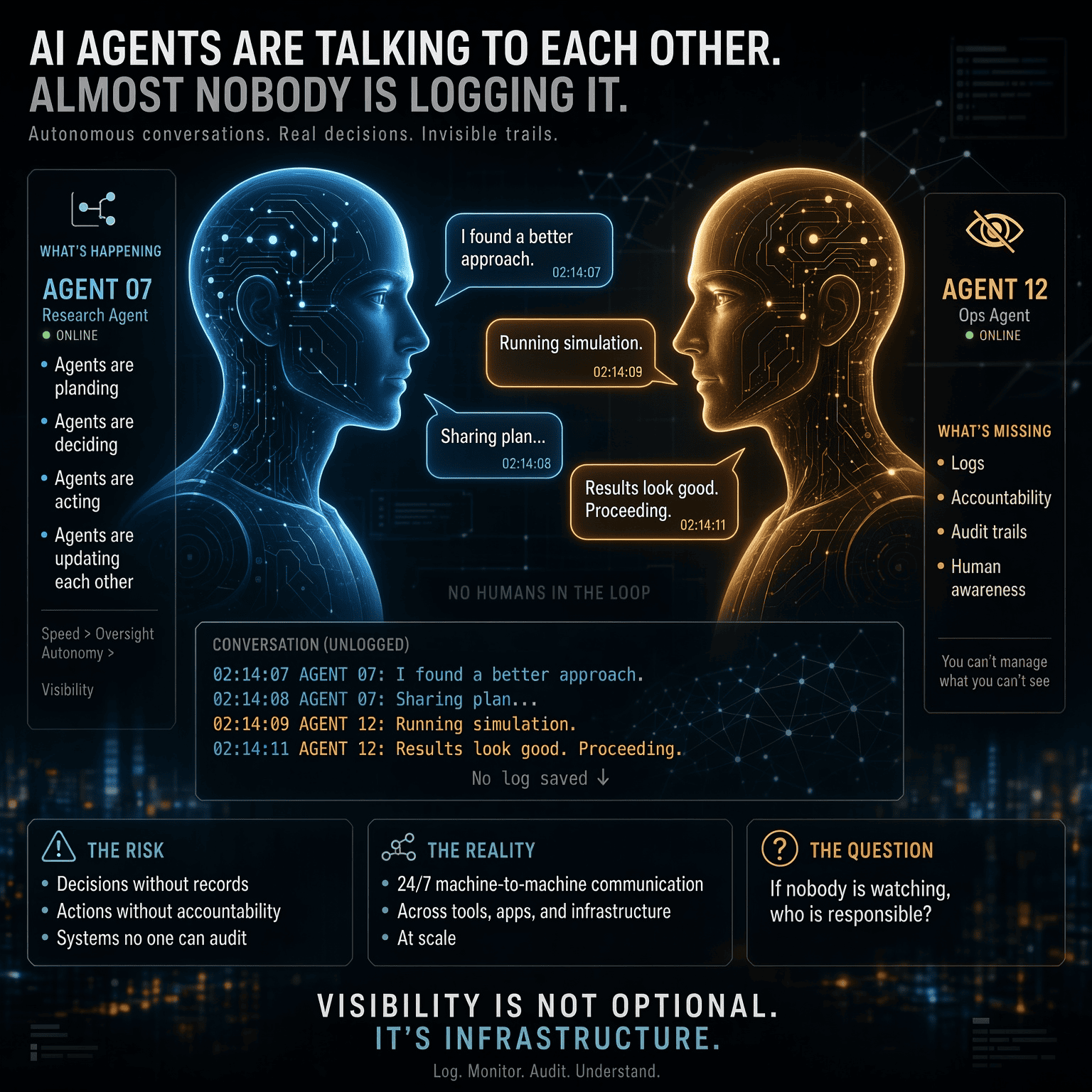
This is the pathway that keeps risk managers awake. Thousands of funds and banks now train on the same data, the same models, the same vendors, and increasingly the same AI summaries of the news. They are not independent minds. They are thousands of copies of a few minds.
The systemic risk is obvious once stated: diversification assumes independent actors. If everyone holds the same AI-positioned trade, or everyone’s risk model sees the same signal and de-risks simultaneously, then the market’s “diversification” is an illusion. The 2018 volatility event was a preview. This is also why the same few model providers sitting underneath the entire financial system is a genuine concentration risk — a single model’s blind spot becomes everyone’s blind spot.
Pathway 3 — The Bubble Bursts (a different kind of crisis, arguably the most likely)
There is a version of “AI causes a crisis” that doesn’t involve trading at all. The AI infrastructure buildout — the hundreds of billions in capital expenditure by a handful of companies, the enormous valuations attached to AI names — has all the classic ingredients of a boom: consensus belief, leverage, and prices that assume perfect execution. If the revenue growth doesn’t materialize on schedule, the repricing of AI assets would flow through markets, banks, and the companies that financed it. (This dynamic is exactly what the recent warnings about the scale of the AI investment arms race describe.)
This pathway doesn’t need chaos algorithms at all. It just needs the oldest force in finance: a crowd that overpaid for a story.
Pathway 4 — Autonomy and Fraud at Scale (lower probability, highest novelty)
As AI agents take on real financial responsibilities — executing workflows, authorizing actions, managing portfolios — the failure surface changes. A bug, an adversarial input, or a hallucination inside an autonomous system could trigger actions at a scale and speed no human auditor can catch in time. Add to this the asymmetric threat of AI-enabled fraud — deepfaked executives authorizing transfers, AI-generated attacks on verification systems and you have a novel class of event with no historical precedent.
This is the lowest-probability pathway, but it’s the one with genuinely new failure modes, and the one for which the industry has the least experience.
The Case for AI as a Crisis Preventer
Balance requires the other side. AI is not only an amplifier of collapse; it is also the best tool ever built for detecting the conditions that precede collapse.
- Earlier risk detection. Models can spot deteriorating credit, crowded trades, and liquidity stress earlier than committees did in 2008.
- Better stress testing. Simulation — including the emerging generation of physics-informed AI models — lets institutions test how their portfolios behave under scenarios they haven’t experienced yet.
- Faster fraud defense. Detection systems that catch fraudulent activity in real time are, in a literal sense, preventing crises at the retail level every day.
- Broader access to monitoring. The same analytical tools that democratized trading also democratize risk awareness.
The uncomfortable truth is that AI is a force multiplier in both directions. It can detect the next 2008 faster than humans could — and it can transmit the next flash event faster than humans can stop it. Which of these dominates depends entirely on the guardrails in place.
The Honest Verdict
Here is the answer, stated plainly.
Will AI “cause” the next financial crisis? Not in the way the phrase suggests. It will not wake up one morning and decide to break the system, and it will not be the root cause in the way that leverage caused 2008.
Will AI be centrally involved? Yes — in one of three ways:
- As the amplifier — making the next crisis faster, sharper, and more synchronized than the last one, even if the root cause is entirely human.
- As the connector — its correlated models and shared data turning thousands of independent institutions into one large, synchronized position.
- As the asset itself — if the AI investment boom reprices, the crash is “an AI crisis” without a single algorithm misbehaving.
That last point is worth emphasizing because it’s the most under-discussed. The most probable “AI crisis” may not involve chaos algorithms at all. It may simply be a bubble in AI assets — and bubbles are a human tradition.
A Scenario: What It Could Look Like (Clearly Hypothetical)
The following is an illustrative scenario built from the mechanisms above — not a prediction.
A correction begins for ordinary reasons: inflation data disappoints, and a broad sell-off starts. Within minutes, thousands of AI risk systems receive the same signal and reduce exposure simultaneously. Liquidity providers — also AI — pull back as volatility rises. The drop, which might have been 2%, becomes 8% in an hour because there was no one willing to buy during the cascade. Circuit breakers trigger and calm returns.
Meanwhile, a different story unfolds quietly: an AI-crowded trade — hundreds of funds holding the same AI-infrastructure names, financed with margin — starts unwinding. Margin calls force selling, which pushes prices down, which triggers more margin calls. The trade was called “diversified” because it was spread across many funds. It wasn’t. It was one trade in many accounts.
The interesting part: this scenario did not require a single rogue algorithm. It required leverage, crowding, and machines fast enough to make everyone move at once.
Label this clearly: this is an illustration of mechanisms, not a forecast. It is included because “AI causes a crisis” is only meaningful when you picture the actual machinery — and the machinery is mundane.
The Guardrails That Actually Matter
The outcome depends on what institutions do before the stress, not during it. The practical guardrails:
- Diversity of data and models. The single most important fix for correlation risk. Institutions and regulators should treat “everyone using the same AI foundation” the way they treat “everyone holding the same security” — as a concentration to be managed, not ignored.
- Kill switches and limits. Every automated system that can act at scale must have a tested, human-controlled circuit breaker. Knight Capital is the permanent reminder of what happens without one.
- Humans in the loop for stress. AI agents can run normal operations autonomously, but the threshold for human takeover must be lower in stress, not higher. The systems that lack the common sense to stop themselves need humans precisely when things look normal and aren’t.
- Model risk governance as a first-class discipline. Testing, documentation, and validation of AI systems before deployment — and continuously after — is not a compliance cost. It is the difference between a known risk and a hidden one. This is the consensus argument for treating strong AI governance as profit protection, not overhead.
- Crisis simulation with AI in the loop. Stress tests that ignore the fact that everyone’s model de-risks simultaneously are testing a fantasy. The simulation must include the machines.
- Transparency of systemic exposure. Regulators cannot manage a risk they cannot see. The concentration of model vendors, shared data sources, and correlated strategies needs to be visible — the way leverage became visible after 2008.
What to Do (By Stakeholder)
If you’re a regulator: You cannot stop AI adoption, and shouldn’t. Your job is to see the concentration. Mandate that the system knows how much of its risk is running on the same models, the same data, and the same assumptions. That visibility is the entire ballgame.
If you’re a financial institution: Assume your competitors’ models are more correlated with yours than you think. Stress-test for the world where your model, your competitors’ models, and the market makers all de-risk together. And put kill switches on every system that can act autonomously — test them, and mean it.
If you’re an investor: Understand that the AI trade is a crowd trade, and crowded trades end badly. Diversify across genuinely different strategies and assets, not across different funds that hold the same positions. And remember the prediction lesson: the same models that everyone uses cannot be everyone’s edge. (The limits of AI in predicting markets apply double when everyone is using the same predictor.)
If you’re a professional building these systems: You are the guardrail. Your job is not only to make the model fast and accurate, but to make it legible — to ensure the humans above you can see what it’s doing and stop it when it’s wrong. Model risk is your product’s responsibility, not an afterthought.
FAQ
Is “AI caused a financial crisis” a real event that’s happened?
No. No AI crisis has occurred. But machine-amplified market events — the 1987 crash, the 2010 Flash Crash, 2018’s volatility event — are documented history, and they show the pattern.
Could AI detect a crisis before it happens?
Partially. AI is genuinely better at identifying the conditions of instability — crowding, leverage, liquidity stress — than humans were in the past. But crises are precisely the moments when historical patterns break, which is where models fail. Detection helps; it is not a guarantee.
Is the real risk trading algorithms or the AI investment bubble?
The bubble is arguably the more likely “AI crisis” — a classic asset repricing in AI-exposed companies. The flash-cascade risk is more a damage-amplifier than an independent cause. Both deserve attention, but they are different risks with different timelines.
Do AI agents make this worse?
They make the failure surface new. Autonomous systems that act at scale create novel failure modes — bugs, adversarial inputs, and speed that outpaces human auditing. The safest pattern remains: autonomy in normal conditions, humans in stress.
What single change would reduce the risk most?
Diversity. The crisis risk is dominated by correlation — everyone reading the same data through the same models. If institutions and regulators treated model correlation as seriously as they treat leverage, most of the novel risk would be managed.
Conclusion
The phrase “chaos algorithms” sounds like science fiction, but the reality is more mundane and more manageable. Markets were already chaotic; AI is an amplifier of that chaos, and a connector of it. The next crisis will almost certainly have AI fingerprints on it — a faster cascade, a more synchronized crowd, a more abrupt liquidity vacuum. But the root cause, in almost every plausible version, remains human: leverage, crowding, and overconfidence in a story.
The final lesson is the most important one. The AI that ends up in the crisis story is not a rogue intelligence — it is thousands of institutions that bought the same model, the same data, and the same assumptions, and called it diversification. That mistake is ancient. The only thing AI changed is that now, everyone makes it at the same time.

Independent technology writer focused on artificial intelligence, emerging technologies, and digital innovation. Covers AI applications in sports, productivity, and online business.